

Key Takeaways
- CIP Spark is a conditional grant of up to RM150,000 over a maximum of 18 months, open to teams of two or more individuals and to young PLT, Enterprise or Sdn Bhd companies. If the funding is terminated, Cradle can require you to pay back what it has disbursed, and other terms in the funding agreement also apply.
- You start by submitting a pitch deck on Cradle’s template through its Grant Management System. Cradle asks for eligibility verification documents only after shortlisting, and estimates two to four months from pitch to approval when your documents are complete.
- Cradle requires at least 60% of the funding to go to development. Build your budget around milestones you can demonstrate, and hold enough cash to cover spending you claim back as reimbursement.
A CIP Spark application asks you to show three things early: that your team qualifies, that your idea can reach a working prototype or MVP within 18 months, and that your spending plan fits Cradle’s 60/40 rule. Our own list of startup grants in Malaysia gives CIP Spark a short entry. This guide goes further. We walk through each stage, the evidence to line up before you are shortlisted, and an example milestone budget you can rework for your own plan.
Every programme rule below comes from Cradle’s official CIP Spark page and related Cradle pages, checked on 16 November 2026. Where Cradle’s wording leaves an edge case open, we say so and suggest the safer reading. Let’s get started.
What CIP Spark Funds: Up to RM150,000 Over 18 Months
Cradle describes CIP Spark as a grant of up to RM150,000 for a maximum of 18 months, covering development and pre-commercialisation for technology startups. The government’s MyGOV portal (updated 30 October 2026) lists the same ceiling and duration.
Here is what that means in practice:
- Stage: Cradle accepts applications at the ideation, prototype development and product improvement stages. Its grants overview calls Spark a pre-seed programme for turning technology-based ideas into MVP-stage products.
- Funding type: It is a conditional grant. One condition is that recipients must pay back the amount disbursed if the funding is terminated. Other terms are set out in the funding agreement.
- Support beyond money: Cradle says recipients also get business networking opportunities and support with business model development, market validation and market access.
The word “conditional” matters. CIP Spark comes with obligations. Before you sign, read the funding agreement line by line, list every event that could lead to termination, and ask a lawyer to review the repayment clauses. A legal review can help you understand that risk before you commit.
Who Can Apply for CIP Spark: Individual Team or Company
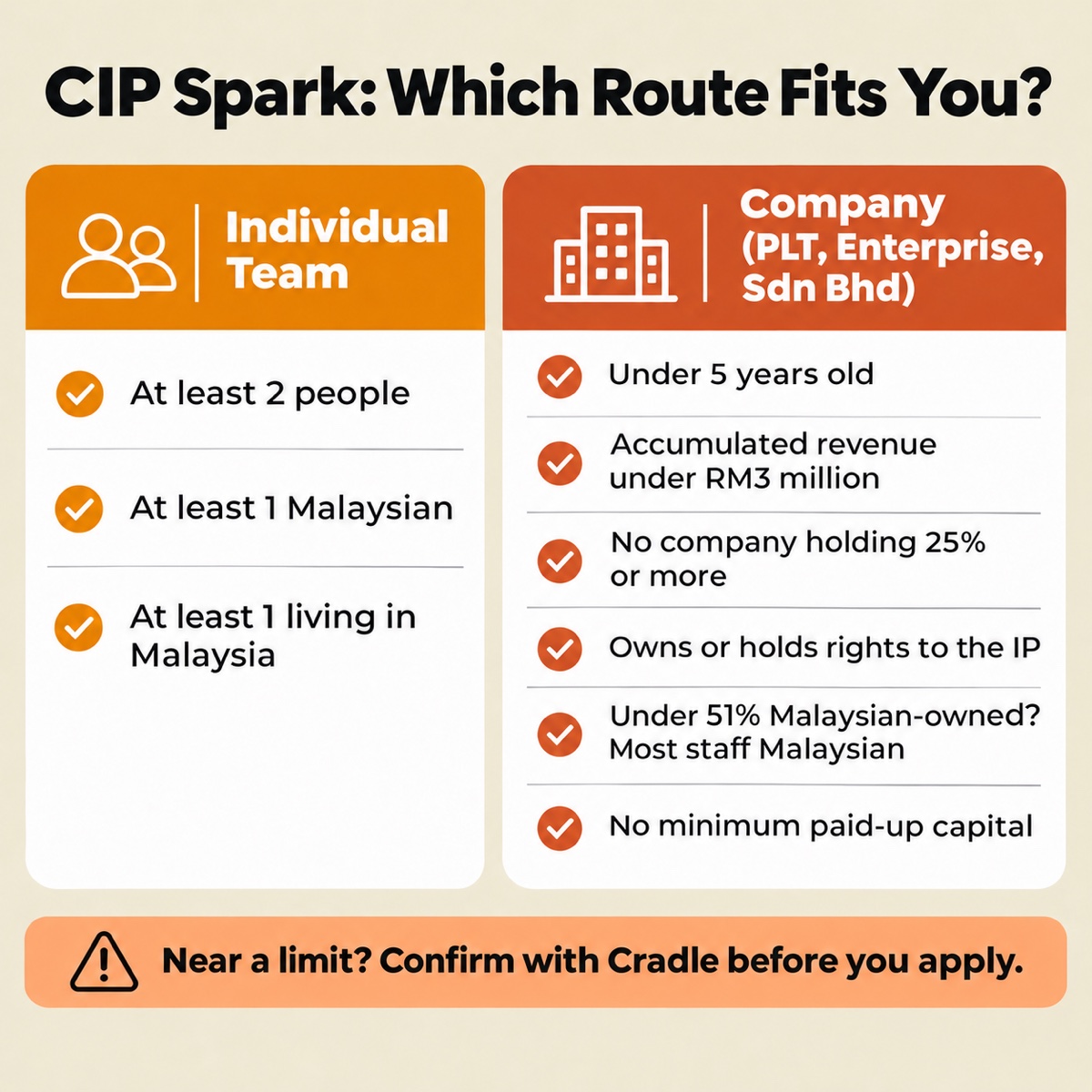
CIP Spark is open to both individuals and companies. The two routes have different rules.
| Requirement | Individual team | Company (PLT/LLP, Enterprise or Sdn Bhd) |
|---|---|---|
| Team or structure | At least 2 individuals | A registered PLT/LLP, Enterprise or Sdn Bhd |
| Nationality and residence | At least 1 Malaysian, and at least 1 member living in Malaysia | If the company is under 51% Malaysian-owned, most employees must be Malaysian |
| Company age | Not applicable | Under 5 years since incorporation |
| Revenue | Not stated | Accumulated revenue under RM3 million. Companies more than 18 months old verify revenue with audited accounts |
| Shareholding | Not applicable | No other company holds 25% or more |
| Intellectual property (IP) | Not stated in the criteria | Must own the IP or hold rights to it. Licensed IP needs a valid exclusive agreement with the applying Sdn Bhd as licensee, on an annual renewable term during the funding period |
| Paid-up capital | Not applicable | No minimum |
University and research institute spin-offs can apply through the company route, as long as the company owns the IP or holds the rights to it.
Where Cradle’s Wording Leaves Edge Cases
Cradle’s criteria box and its FAQ use slightly different words on the same page. If your situation sits close to a limit, take the stricter reading and confirm with Cradle before you submit.
- Shareholding: the criteria say no other company may hold “25% or more”. The FAQ says no other company or entity may hold “more than 25%”. If one shareholder sits at exactly 25%, treat it as a risk and ask first.
- Company age: the criteria say “< 5 years of incorporation”, while the FAQ says the company “shall not be more than 5 years old”. If you are close to your fifth anniversary, check before you apply.
- Revenue: the criteria say “< RM3 million”, while the FAQ says accumulated revenue “must not exceed RM3 mil”. Aim to sit clearly below RM3 million.
- Individual teams: the FAQ mentions non-Malaysians living in Malaysia, but the criteria box requires at least one Malaysian in the team. Plan for at least one Malaysian member.
- Licensed IP outside a Sdn Bhd: the licensing rule names “the applying Sdn Bhd” as licensee. If you are a PLT or Enterprise relying on a licence, ask Cradle how it applies to you.
- Audited accounts: the revenue check for companies older than 18 months uses audited accounts. If your business type does not usually prepare audited accounts, ask which records Cradle will accept.
How to Choose Your Route
Ask yourself two questions. Have you registered a business yet? And who will own the IP?
- Not registered yet: the individual route lets a team of two or more apply before incorporating. Cradle’s criteria box sets no IP rule for this route, so agree in writing now on who created what and how the IP will be held later. Ask Cradle whether you will need to incorporate before signing an agreement or receiving funds.
- Already a PLT, Enterprise or Sdn Bhd: check age, revenue and shareholding against the table. If you are past five years or above RM3 million in accumulated revenue, CIP Spark does not fit. CIP Sprint has different limits (see the FAQ below).
The CIP Spark Application Process, Step by Step
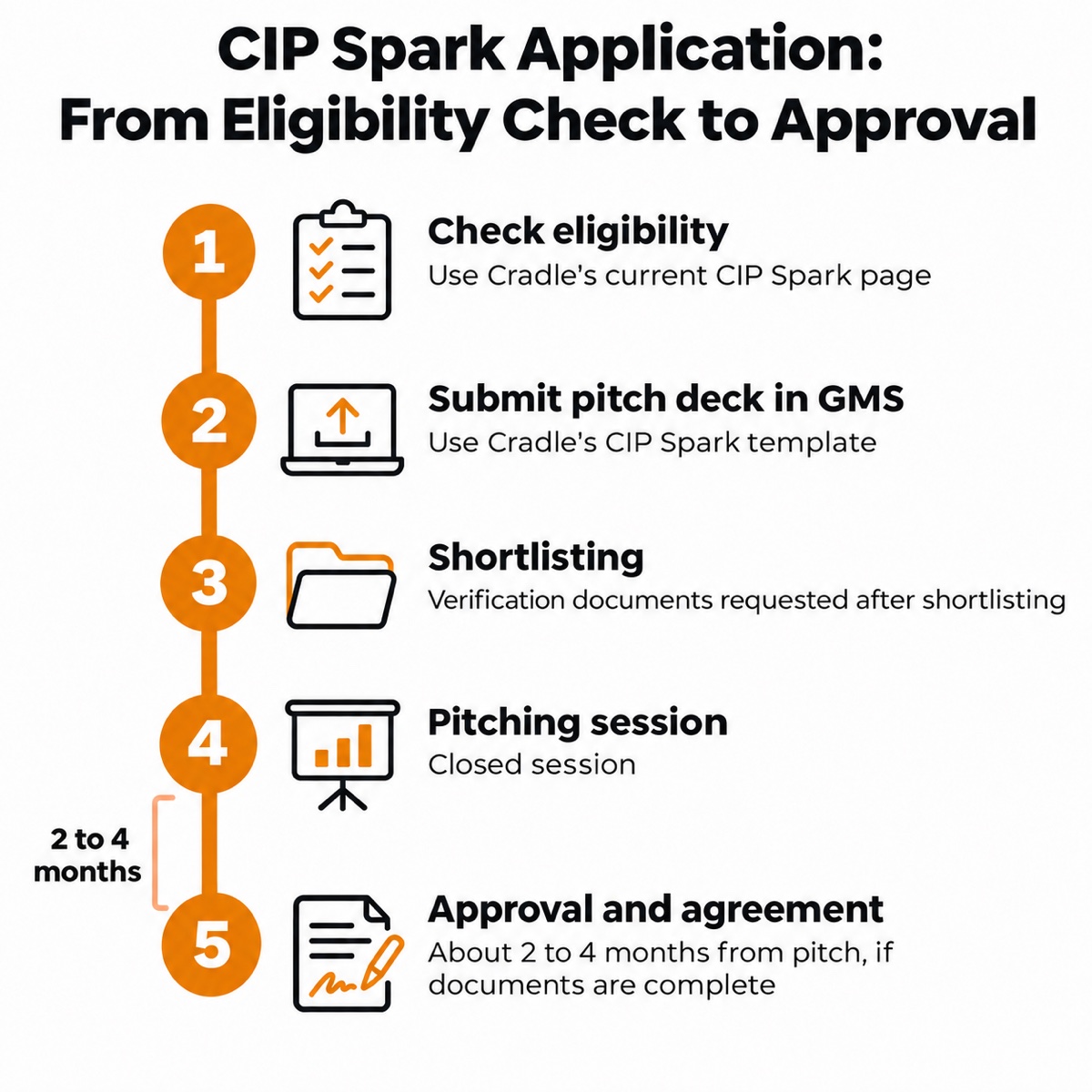
Cradle’s CIP Spark page asks you to register and apply online through its Grant Management System (GMS), and the page’s “Apply Now” buttons lead there. Third-party guides sometimes describe a different route, so start from the link on Cradle’s own CIP Spark page. Cradle does not publish a single step-by-step process, so we pieced together the sequence below from its CIP Spark page and FAQ.
- Check eligibility. Read the current CIP Spark page and note the date you checked it. Rules can change.
- Register and submit your pitch deck. Create a GMS account and submit a pitch deck based on the template Cradle provides. At this stage, the deck is the main document Cradle asks for.
- Shortlisting and verification. Cradle asks for documents to verify eligibility only once your application is shortlisted.
- Pitching session. Accepted applications are called to pitch. Cradle runs these as closed sessions.
- Approval and funding agreement. Cradle estimates two to four months from pitching to approval, provided your documents are complete.
Two timing points are worth planning around:
- Cradle publishes the pitch-to-approval estimate but no estimate for the time between submission and the pitch call. Don’t build your runway on a grant date you cannot confirm.
- Incomplete documents are the one delay Cradle names. Have your records ready before you are shortlisted (next section).
Cradle’s CIP Spark page does not publish an intake calendar or deadline. Check GMS, or ask Cradle directly, for the current intake status before you set internal deadlines.
What to Prepare Before and After Shortlisting
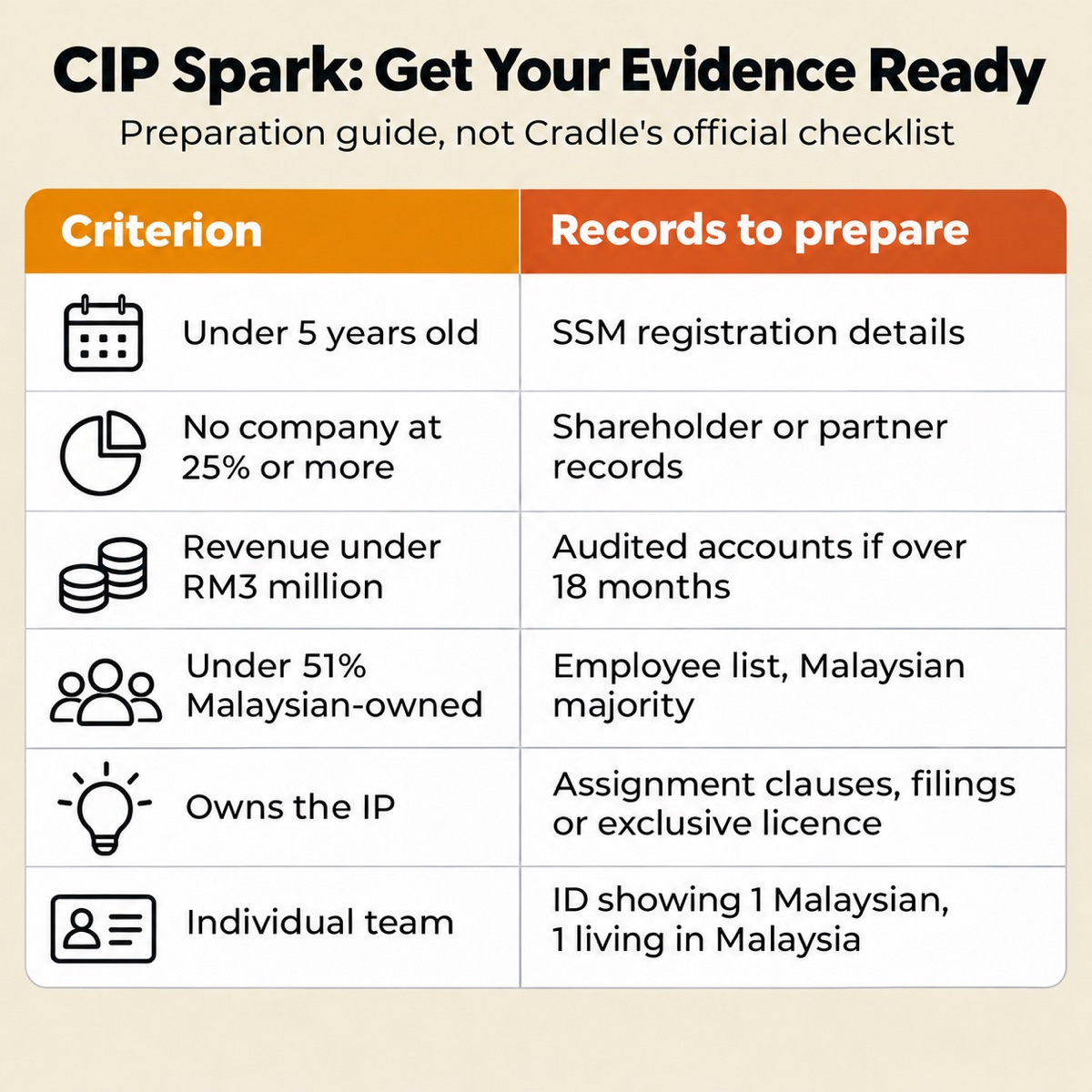
You submit one main document first and verification documents later. Prepare both from day one.
Your Pitch Deck (Needed at Submission)
Use the current CIP Spark template from Cradle and follow its structure. Don’t paste in an investor deck as it is. Cradle’s published rules point to five things your deck should make clear:
- Where your product is today: idea, prototype or existing product you are improving.
- What you will deliver: Cradle expects at least a functional prototype or MVP by the end of funding.
- Who owns the technology: your IP position, stated plainly.
- How you will spend the money: a milestone budget that puts at least 60% of the funding into development.
- Why this team: the people and skills that will build it. Cradle’s rules do not spell this out, but a panel will want to know who will deliver the plan.
Our guide to writing a startup pitch deck in Malaysia covers storytelling and slide design in more depth. Use it for the craft, and use Cradle’s template for the order.
Evidence You May Be Asked For After Shortlisting
Cradle does not publish its verification checklist. The table below maps each published criterion to the records that usually prove it. Treat it as preparation, not as Cradle’s official list.
| Published criterion | Records to have ready |
|---|---|
| Company under 5 years old | SSM registration details showing your incorporation or registration date |
| No company holding 25% or more | Current shareholder or partner records |
| Accumulated revenue under RM3 million | Audited accounts if you are more than 18 months old. Your latest financial statements if younger (ask Cradle what it accepts) |
| Under 51% Malaysian-owned | Shareholder nationalities and an employee list showing a Malaysian majority |
| Own the IP or hold rights to it | IP assignment clauses in founder, employee and contractor agreements, any patent or trademark filings, or the exclusive licence agreement |
| Individual team | Identity documents showing at least one Malaysian member and one member living in Malaysia |
Close IP Gaps Early
IP ownership is easy to assume and harder to prove. Check these three situations now:
- Freelancers and agencies: if a contractor wrote your code or designed your hardware, check that your contract assigns the IP to the applicant.
- Co-founders who left: confirm in writing that their contributions belong to the company or team.
- University research: spin-offs need the company to own the IP or hold the rights. Start the licence or assignment process with the university’s commercialisation office early, as these agreements can take time.
How to Build a CIP Spark Milestone Budget Around the 60/40 Rule
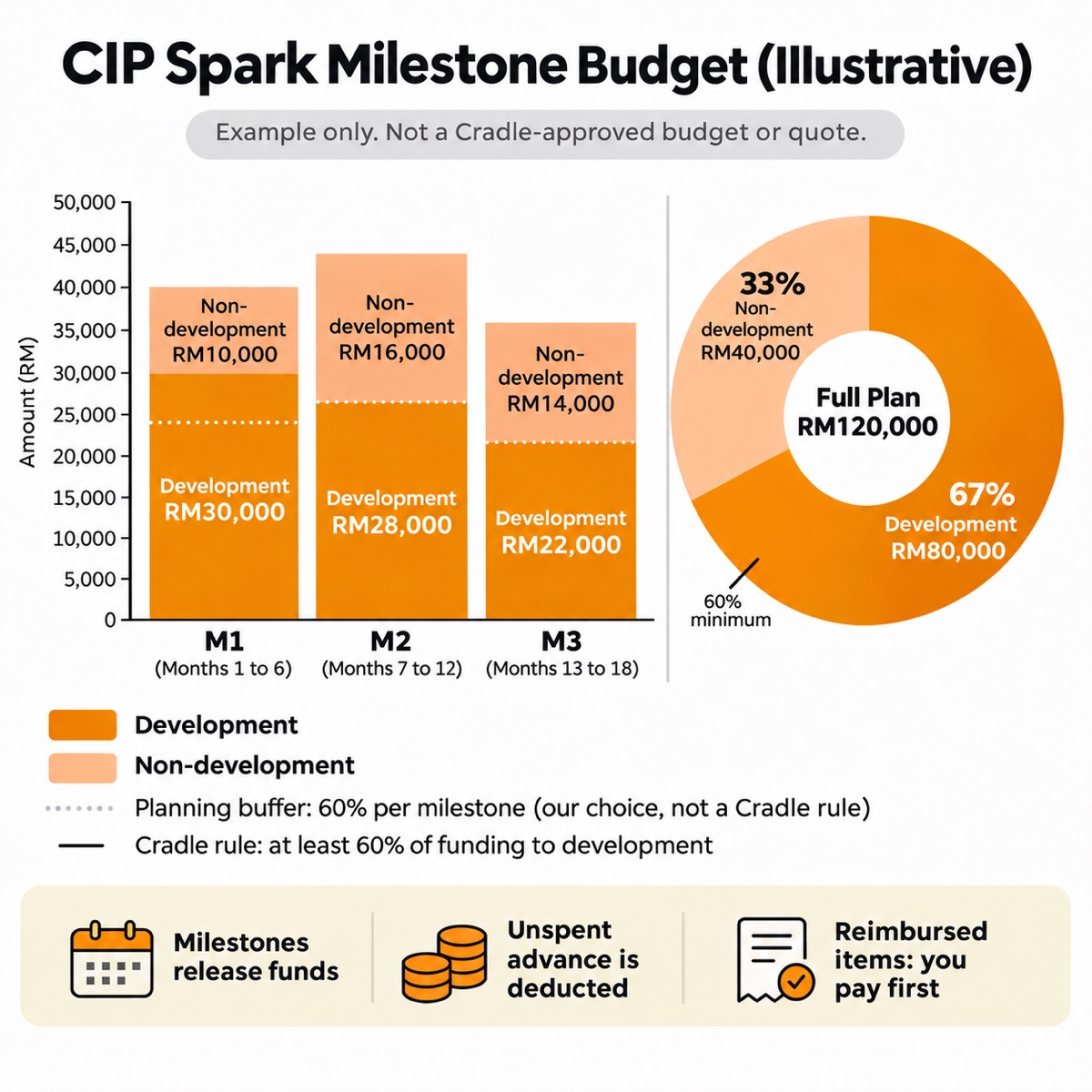
Cradle sets one clear spending rule: at least 60% of the funding goes to developmental expenses, and at most 40% to non-developmental expenses, which include commercialisation costs.
At the full RM150,000 ceiling, that means at least RM90,000 for development and no more than RM60,000 for everything else. You don’t have to ask for the maximum. Ask for what your milestones need, and be ready to defend every line.
An Illustrative RM120,000 Worksheet
The example below shows how a technology team might lay out an 18-month plan. Two things are worth keeping apart:
- Cradle’s rule: at least 60% of the funding goes to development. That is the requirement Cradle publishes.
- Our planning choice: Cradle does not say whether it also checks the split on each milestone or claim. As a cautious buffer, this example keeps each milestone above 60% as well. That is not a Cradle requirement, so ask Cradle how it reviews the split before you decide whether you need the same buffer.
The overall split is about 67/33, which also leaves headroom if Cradle classes a line item differently from you.
| Milestone | Months | Output you can demonstrate | Development (RM) | Non-development (RM) | Total (RM) | Development share |
|---|---|---|---|---|---|---|
| M1 | 1 to 6 | Working prototype tested with 10 target users | 30,000 | 10,000 | 40,000 | 75% |
| M2 | 7 to 12 | MVP feature-complete, running a small pilot | 28,000 | 16,000 | 44,000 | 64% |
| M3 | 13 to 18 | MVP ready for launch, demo session delivered | 22,000 | 14,000 | 36,000 | 61% |
| Total | 18 | 80,000 | 40,000 | 120,000 | 67% |
Behind each milestone, list your real line items with a quote or price source for each. Then sort them into development and non-development using Cradle’s current guidance, not your own assumptions. Cradle decides which expenses are allowable and how each one is classed, so confirm any cost you are unsure about before you submit.
Illustrative only. This worksheet is an example structure, not a Cradle-approved budget, a supplier quote or a promise of funding. The milestone outputs and amounts are examples. Check every line against Cradle’s current guidance before you submit.
Plan Cash Flow for Advance Payments and Reimbursements
Cradle pays CIP Spark through a mix of advance payments and reimbursements. Three rules shape your cash flow:
- Milestones release money. You must meet milestone deliverables before the next advance payment or reimbursement.
- Unspent advance reduces the next one. Cradle deducts any unused amount from your next advance payment.
- Reimbursement means you pay first. For reimbursed items, your team covers the cost and claims it back.
So keep a cash buffer for reimbursed spending, and define each milestone by an output you can show, such as a working build or pilot results, rather than effort spent. Cradle does not publish how much is paid as an advance and how much as reimbursement, so ask how the split will work under your agreement.
Preparing for the CIP Spark Pitching Session
Cradle does not publish its scoring criteria, so build your pitch around what the rules ask you to deliver: a functional prototype or MVP within the funding period, on a budget that meets the 60/40 rule.
- Make each milestone testable. Within the template’s structure, show each milestone’s output, date, budget and how you will prove it.
- Keep your numbers identical everywhere. The totals on your slides, your budget sheet and your verbal answers should match to the ringgit.
- Show your IP position in one sentence. “The company owns the code under signed assignment agreements” is stronger than a vague claim.
- Name your risks. Point out the hardest technical step and your backup plan.
- Rehearse with a sceptic. Ask a mentor or another founder to question your 60/40 split and your timeline. Then fix the weak answers.
Pitch sessions are closed, and Cradle states that it keeps your idea private and confidential. That lets you be specific about your technology. Keep your IP assignment records in place all the same, because confidentiality does not prove ownership.

After Approval: Deliverables and What Comes Next
Approval starts the real work. Cradle expects at least a functional prototype or MVP by the end of funding. You will also run a demo session and submit development progress reports during the funding period.
To stay on track:
- Keep a simple spend log per milestone, with receipts filed as you go.
- Hold a monthly check against your milestone outputs, not only against spending.
- Raise problems with Cradle early. Repayment can apply on termination, so small issues are cheaper to fix than to hide.
CIP Spark funds the build up to an MVP. Once you have an MVP and early users, your options widen. Our overview of startup funding in Malaysia maps the main routes. Teams planning to raise equity can read our guide to venture capital for Malaysian startups and angel investors. And if your product already has an engaged user base, equity crowdfunding for Malaysian startups is another route to compare.
Build Your CIP Spark Application at WORQ
A strong CIP Spark application comes from focused work sessions: mapping milestones, testing prototypes and rehearsing the pitch until every number holds up. That is easier with a proper desk, a meeting room for practice runs and other founders working nearby.
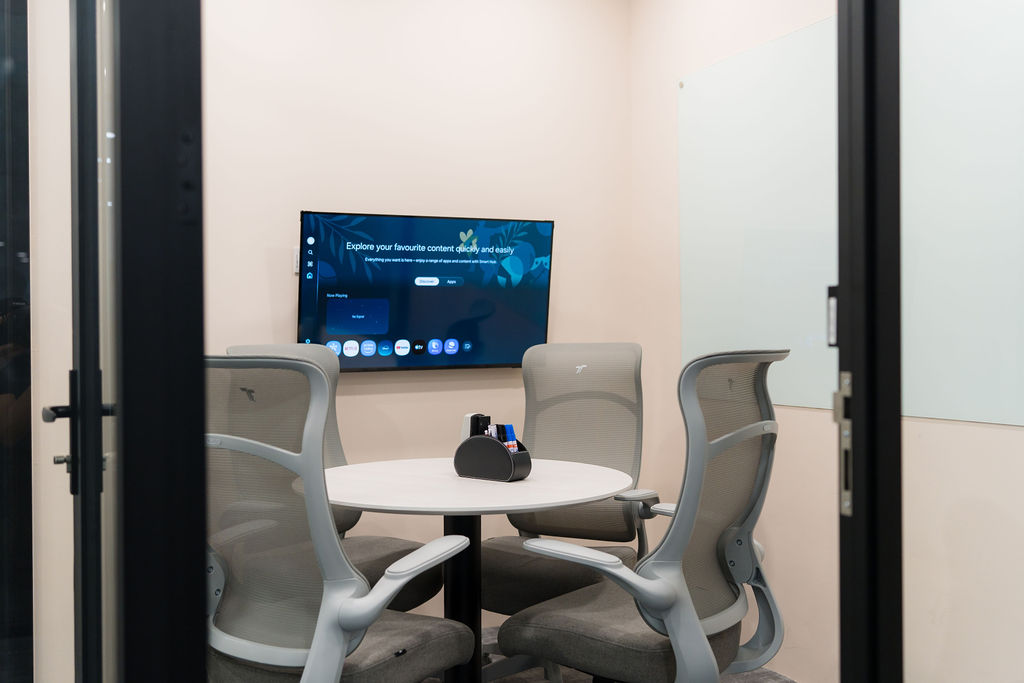
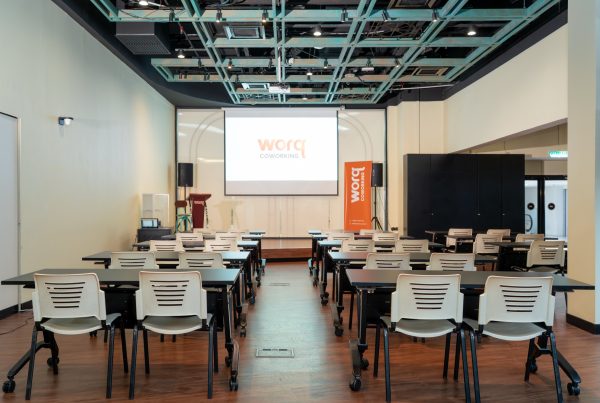
Our WORQ Sunway Putra space is in Sunway Putra Mall at 100 Jalan Putra, a minute’s walk from PWTC LRT station. Cradle’s office is nearby, in Sunway Putra Tower. Your team can work there and book a meeting room by the hour, half-day or full day for pitch rehearsals. If another part of the Klang Valley suits your team better, you can compare all WORQ coworking locations and book a visit.
Your next step today: open the CIP Spark page, run your team through the eligibility table above, and draft your three milestones. We’d love to help you work on the rest together.
FAQ
How is CIP Spark different from CIP Sprint?
Cradle calls CIP Spark a pre-seed programme and CIP Sprint a seed programme. Sprint is a conditional convertible grant of up to RM600,000 over a maximum of 18 months. It is open only to Sdn Bhd companies under seven years old at the point of application, with accumulated revenue below RM5 million and paid-up capital of at least RM10,000. It reverses the spending focus: at least 60% goes to commercialisation, and Cradle says traction data will support and strengthen an application.
Do I need users or revenue before I apply for CIP Spark?
Not necessarily. Cradle says this depends on the stage of your product. An idea-stage team can apply without traction. If you already have early users, include the evidence, because it shows your milestones rest on real feedback.
Who should I contact if my case sits on an eligibility edge?
Contact Cradle directly through its contact page, by email at [email protected] or by phone on +603 4045 8600. Ask one specific question per issue, include the exact figure (for example, a shareholder at 25%, or accumulated revenue to date) and keep the written reply with your application records.




 Enjoy exclusive wellness benefits with Atlas Chiropractic & Physiotherapy, supporting desk-bound professionals with evidence-based chiropractic and physiotherapy care.