
Key Takeaways
- A strong pitch deck is the single most important document for raising startup funding in Malaysia, whether you are approaching angel investors, VCs, or equity crowdfunding platforms.
- Malaysian investors expect 10 to 15 slides covering the problem, solution, market size, traction, business model, team, and use of funds.
- Prepare a reusable document pack (pitch deck, executive summary, financial model, company profile) that can be adapted for different investor types.
- Tailor your pitch to the investor type: angels care about founder conviction, VCs focus on scalability, and ECF platforms prioritize retail investor clarity.
- Your deck’s emphasis should match your funding stage. Pre-seed decks lean on the problem and founder conviction, while Series A decks need strong unit economics and a clear growth trajectory.
- Narrative structure matters as much as slide content. The best decks follow a three-part story: tension, resolution, and invitation.
Startup pitch deck Malaysia founders send out is often the first and only chance to make an impression on an investor. Most startups that fail to raise funding do not fail because of a bad idea. They fail because they cannot communicate the idea clearly to the right investor at the right time.
Whether you are applying for a Cradle CIP Spark grant, pitching to an angel network, or raising a Series A from a regional VC, the pitch deck is the document investors will evaluate first. This guide covers exactly what to include, what to avoid, and how to adapt your deck for different funding channels in Malaysia. For a full overview of every funding option available, start with our complete guide: 8 ways to get startup funding in Malaysia and how to apply.
The stakes are real. Malaysia now has over 5,000 registered startups, more than double the count from 2022. In 2025, Malaysian startups raised US$140 million across 157 rounds, while Southeast Asia as a whole saw US$6.79 billion deployed across 335 equity deals. Kuala Lumpur was ranked 18th globally in the 2025 Global Startup Ecosystem Report. Competition for investor attention is intensifying, and your pitch deck is the first filter.
What Is a Startup Pitch Deck?
A pitch deck is a short presentation (typically 10 to 15 slides) that summarizes your startup’s business opportunity for potential investors. It is usually shared as a PDF and serves as the first filter in any fundraising conversation.
The pitch deck is not a business plan. It is a concise, visual story that answers one question: why should this investor put money into this company right now?
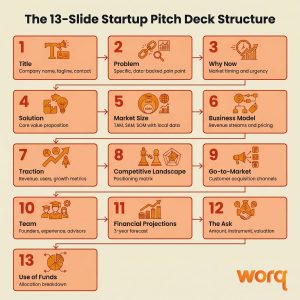
The 13-Slide Pitch Deck Structure
While there is no universal format, the following structure aligns with what Malaysian VCs and angel investors expect to see. Adjust the order based on your strongest points, but cover all 13 areas.
Slide 1: Title
Company name, tagline, your name and role, and contact details. Keep it clean. One sentence that captures what you do.
Slide 2: Problem
Define the specific problem your target customer faces. Use data or a real scenario to make it tangible. Avoid abstract, global-scale problem statements. Malaysian investors respond better to problems they can verify locally.
Slide 3: Why Now?
Explain why this is the right moment for your startup. Reference market shifts, regulatory changes, technology trends, or behavioral patterns that create urgency for your solution.
In the Malaysian context, this could include government digitalization programmes, sector-specific policy tailwinds like the National Energy Transition Roadmap, shifting consumer behaviors post-pandemic, or regional expansion opportunities driven by ASEAN economic integration.
This slide separates a good idea from a ready investment. Malaysian VCs increasingly expect founders to articulate timing alongside opportunity. If you cannot answer “why now?” convincingly, investors will assume the market is not ready.
Slide 4: Solution
Explain how your product or service solves the problem. Focus on the core value proposition. Do not list every feature. Show, do not tell: a screenshot, demo link, or short product walkthrough works well here.
Slide 5: Market Size
Quantify the opportunity using TAM (Total Addressable Market), SAM (Serviceable Addressable Market), and SOM (Serviceable Obtainable Market). Use credible Malaysian or Southeast Asian data sources. Investors will verify these numbers.
Common mistake: Citing a global market size without narrowing to your actual addressable segment. If you are a Malaysian B2B SaaS company, your SOM is not the global SaaS market.
Slide 6: Business Model
How does the company make money? Show your revenue streams, pricing model, and unit economics if available. For early-stage startups, a clear explanation of how you plan to monetize is sufficient. For Series A, investors expect actual revenue data and contribution margins.
Slide 7: Traction
This is often the most important slide. Show measurable progress:
- Revenue or MRR (Monthly Recurring Revenue)
- Number of paying customers or active users
- Growth rate (month-on-month or quarter-on-quarter)
- Key partnerships or pilot programmes
- Waitlist size or LOIs (Letters of Intent)
For pre-seed founders without revenue, show customer discovery data, user interviews, or MVP engagement metrics. The point is to demonstrate that real people want what you are building.
Slide 8: Competitive Landscape
Map your competitors and show where you fit. A 2×2 positioning matrix works well. Be honest about competitors. Investors know they exist. What matters is your differentiation and defensibility.
Slide 9: Go-to-Market Strategy
How will you acquire customers? Outline your primary channels (direct sales, partnerships, content marketing, referrals) and explain why they are right for your market. Include customer acquisition cost (CAC) if you have it.
Slide 10: Team
Introduce the founding team with relevant experience and domain expertise. Highlight complementary skill sets. If you have notable advisors or board members, include them. Investors in Malaysia place heavy weight on founder credibility and execution track record.
Slide 11: Financial Projections
Show a 3-year financial forecast with revenue, expenses, and key assumptions. Keep it realistic. Investors will challenge aggressive projections. Include your current burn rate and runway if you are already operating.
Slide 12: The Ask
State exactly how much you are raising, what type of instrument (equity, SAFE, convertible note), and the target valuation or cap. Be specific. Vague asks signal that you have not done the financial planning.
Slide 13: Use of Funds
Break down how the investment will be allocated. Common categories include product development, hiring, marketing, and operations. Use percentages or absolute figures. Investors want to see that you have a plan for every ringgit.
Telling a Story, Not Just Presenting Slides
The structure above gives you a framework. What separates funded decks from ignored ones is the narrative arc that connects each slide.
Strong pitch decks follow a three-part story:
1. Tension (Slides 1 to 4). Establish the world as it is: a real problem, a market moment that makes it urgent, and a gap that no one has properly filled.
2. Resolution (Slides 5 to 9). Present your answer: the product, the opportunity, the traction, the model, and the competitive position that proves this works.
3. Invitation (Slides 10 to 13). Bring the investor into the story: the team they are backing, the financials that map the path forward, and the specific ask that lets them participate.
Each slide should flow into the next. If an investor can read your deck start to finish and retell the story to a partner in two sentences, your narrative is working.
Practical tip: Before finalizing your deck, read it aloud to someone outside your industry. If they cannot summarize the story in under 30 seconds, simplify.
The Reusable Document Pack
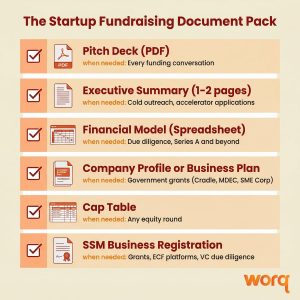
Beyond the pitch deck, Malaysian investors and grant bodies typically request supporting documents. Prepare these once and keep them updated:
| Document | Purpose | When Needed |
|---|---|---|
| Pitch deck (PDF) | First-impression summary for investors | Every funding conversation |
| Executive summary (1 to 2 pages) | Quick overview for time-pressed investors | Cold outreach, accelerator applications |
| Financial model (spreadsheet) | Detailed projections, unit economics, assumptions | Due diligence, Series A and beyond |
| Company profile or business plan | Full company overview, market analysis, strategy | Government grants (Cradle, MDEC, SME Corp) |
| Cap table | Current ownership structure | Any equity round |
| Business registration certificate (SSM) | Proof of incorporation | Grants, ECF platforms, VC due diligence |
Having this pack ready before you start fundraising saves weeks of back-and-forth and signals professionalism to investors.
Tailoring Your Pitch for Different Investor Types
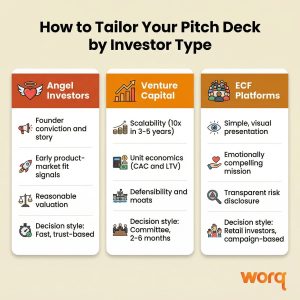
Not all investors evaluate startups the same way. Here is how to adjust your pitch for the three main funding channels in Malaysia.
For Angel Investors
Angels invest personal money and make faster decisions. They care most about:
- Founder conviction and story. Why are you the right person to solve this problem?
- Early signals of product-market fit. Customer conversations, waitlist traction, or a working prototype.
- Reasonable valuation. Over-valuing at seed stage is a common dealbreaker.
Keep the pitch conversational. Angels often decide based on trust and gut feeling, backed by data. Learn more about how angel investors and VCs work in Malaysia to understand what they prioritize.
For Venture Capital Firms
VCs manage institutional money and follow structured evaluation processes. They focus on:
- Scalability. Can this business grow 10x in 3 to 5 years? Can it expand across Southeast Asia?
- Unit economics. What does it cost to acquire a customer, and what is the lifetime value?
- Defensibility. What prevents a well-funded competitor from copying this?
Expect multiple meetings, a formal due diligence process, and a longer timeline (2 to 6 months from first meeting to term sheet).
For Equity Crowdfunding (ECF) Platforms
ECF platforms like pitchIN and Ata Plus serve retail investors who may not have deep startup expertise. Your pitch needs to be:
- Simple and visual. Avoid heavy jargon. Use infographics and clear charts.
- Emotionally compelling. Retail investors connect with the mission and story.
- Transparent about risks. ECF regulations require clear risk disclosure, and honest communication builds investor confidence.
For a deeper look at how equity crowdfunding and P2P lending work in Malaysia, we put together a separate guide with platform details and fundraising data.
How Your Deck Changes by Funding Stage
The same 13-slide framework applies at every stage, but the weight shifts significantly. Here is what investors prioritize at each round.
| Element | Pre-Seed | Seed | Series A |
|---|---|---|---|
| Primary focus | Problem clarity and founder conviction | Product-market fit signals | Scalable growth and unit economics |
| Traction expected | Customer interviews, LOIs, MVP usage | Early revenue or strong user growth | Consistent MRR, clear growth trajectory |
| Financial detail | High-level assumptions and burn rate | 12 to 18-month forecast with key metrics | Full 3-year model with unit economics |
| Team slide weight | High (investors bet on founders) | High (execution track record matters) | Moderate (team depth and hires planned) |
| Typical deck length | 10 to 12 slides | 12 to 15 slides | 15 to 20 slides with appendix |
| Common raise (Malaysia) | RM100K to RM500K | RM500K to RM3M | RM3M to RM15M+ |
Key takeaway: Do not over-build your deck for your stage. A pre-seed founder presenting a 20-slide deck with detailed five-year projections signals misaligned priorities. Match your depth to your stage.
Common Pitch Deck Mistakes to Avoid
Too many slides. If your deck exceeds 15 slides, cut ruthlessly. Investors scan decks in 3 to 5 minutes on first pass. Every slide must earn its place.
No traction slide. Even pre-revenue startups can show traction through customer interviews, LOIs, partnerships, or waitlists. Skipping this slide suggests you have not validated the idea.
Vague market sizing. “The global market is worth USD 50 billion” means nothing if your SOM is RM2 million. Size the market from the bottom up using your actual pricing and target customer count.
Generic competitor analysis. Saying “we have no competitors” is a red flag. Every startup has competitors, even if they are indirect alternatives. Show that you understand the landscape.
Missing the ask. Investors should never have to guess how much you are raising or what you will do with the money. State it clearly on a dedicated slide.
Sending the wrong format. Always send as PDF unless told otherwise. Avoid link-only sharing tools that restrict downloads, as many investors prefer to store and share decks internally.
Ignoring the 10/20/30 rule. Guy Kawasaki’s framework recommends 10 slides, a 20-minute presentation, and a minimum 30-point font size. While the ideal slide count varies (this guide uses 13), the underlying principle holds: keep it concise, respect the investor’s time, and make every word readable from across the room.
No narrative arc. Listing facts across 13 slides is not a pitch. Investors need a story with tension, resolution, and an invitation to participate. If your deck reads like a report instead of a story, rewrite the transitions between slides until the flow is natural.
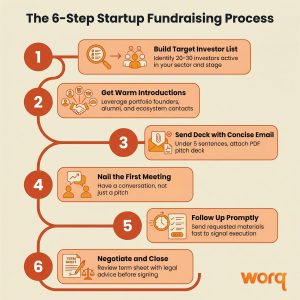
The 6-Step Fundraising Process
Once your pitch deck and document pack are ready, follow this process to start raising.
Step 1: Build Your Target Investor List
Identify 20 to 30 investors who are active in your sector and stage. Use MYStartup, MBAN’s directory, and NEXEA’s network as starting points. Research their portfolio to confirm fit before reaching out.
Step 2: Get Warm Introductions
Cold emails have low conversion rates. Ask founders in the investor’s portfolio, accelerator alumni, or ecosystem participants to make introductions. One warm intro is worth 10 cold emails.
Step 3: Send the Deck with a Concise Email
Keep the email under 5 sentences. State who you are, what the company does, the traction to date, and the ask. Attach the pitch deck as a PDF.
Step 4: Nail the First Meeting
The first meeting is not a pitch. It is a conversation. Be prepared to discuss your business at depth, but also listen. Understand what the investor cares about and what their decision process looks like.
Step 5: Follow Up with Requested Materials
After the meeting, send any additional documents promptly (financial model, customer references, product demo). Speed and responsiveness signal execution ability.
Step 6: Negotiate and Close
If the investor expresses interest, expect a term sheet outlining valuation, equity stake, board rights, and other conditions. Get legal advice before signing. Do not rush this step.
Tools for Building Your Pitch Deck
You do not need a design team to produce a professional deck. These tools help founders create, refine, and share pitch materials efficiently.
- Google Slides or Canva. Free, collaborative, and sufficient for most seed-stage decks. Both offer pitch deck templates as starting points. Start with a proven template structure rather than designing from scratch.
- Gamma and Beautiful.ai. AI-assisted presentation builders that auto-format slides and suggest layouts based on your content. Useful for founders who want polished visuals without design skills.
- Slidebean. Offers pitch deck templates modeled on successful startup raises, with an AI design assistant that handles layout while you focus on content.
- Pitch. Collaborative presentation tool with built-in analytics to track how investors interact with your shared deck.
- DocSend. Not a design tool, but essential for sharing. DocSend tracks which slides investors spend the most time on, giving you data to optimize your deck before the next send.
Tip: Adapt the layout to your brand, but do not reinvent the slide order. Investors expect a familiar flow. A clean, consistent deck built from a template will always outperform a custom design that confuses the reader.
Pitch Deck Checklist
Before sending your deck to any investor, run through this final check:
- [ ] 10 to 15 slides maximum
- [ ] Problem is specific and data-backed
- [ ] Solution is clear in one sentence
- [ ] Market size uses bottom-up methodology
- [ ] Traction slide has real numbers
- [ ] Business model explains revenue streams
- [ ] Team slide highlights relevant experience
- [ ] Financial projections are realistic (3-year)
- [ ] The ask states exact amount and use of funds
- [ ] Design is clean, consistent, and professional
- [ ] Saved as PDF with a clear filename (e.g., “CompanyName_PitchDeck_Mar2026.pdf”)
- [ ] “Why Now?” slide articulates market timing
- [ ] Deck depth matches your funding stage
- [ ] Narrative flows as a story (tension, resolution, invitation)
Start Building Your Pitch at WORQ
The best pitch decks are not built in isolation. They are sharpened through feedback from other founders, mentors, and investors who have seen hundreds of decks before.
Malaysia has a growing ecosystem of pitch practice opportunities. 1337 Ventures runs Pitch Tuesday, a virtual pitch session where early-stage founders can present directly to active investors. The MYStartup Accelerator offers structured programmes with pitch coaching and access to government-backed funding. Angel networks like MBAN regularly host demo days and investor meetups across Kuala Lumpur.
At WORQ, we host regular startup events, pitch practice sessions, and networking mixers where you can test your deck with real audiences before approaching investors. With over 10,000 community members across Kuala Lumpur, you will find founders, mentors, and investors who can give you honest, practical feedback.
Whether you need a hot desk for focused pitch prep or a private office for your growing team, we have flexible workspace options that fit your stage. Use our office space calculator to find the right setup, and check out WORQ locations to pick a base for your next chapter of growth.
Frequently Asked Questions
How many slides should a startup pitch deck have?
The standard is 10 to 15 slides. Investors typically scan a deck in 3 to 5 minutes during the first pass. Every slide should serve a clear purpose. If a slide does not directly strengthen your case, remove it.
Do I need a pitch deck for government grants in Malaysia?
Government grants for startups (Cradle CIP Spark, MDEC grants, SME Corp programmes) typically require a business plan and project proposal rather than a pitch deck. However, having a pitch deck ready is still useful for introductory conversations and accelerator applications.
What format should I send my pitch deck in?
PDF is the standard. Most investors prefer a downloadable file they can store and share internally. Avoid presentation formats (PPTX, Keynote) unless specifically requested, and avoid link-only sharing tools that restrict downloads.
How long does it take to raise funding in Malaysia?
Timelines vary by funding type. Angel rounds can close in 4 to 8 weeks. VC rounds (Series A) typically take 3 to 6 months from first meeting to money in the bank. ECF campaigns run for 30 to 60 days on average. Grant applications can take 4 to 12 weeks for approval. For a broader view of timelines across all funding types, check our complete startup funding guide.
Should I include financial projections if I am pre-revenue?
Yes. Even without revenue, investors expect to see a financial model that shows your assumptions about customer acquisition, pricing, costs, and path to breakeven. The projections demonstrate your understanding of the business, not just optimistic guesses.
What is the difference between a pitch deck and a business plan?
A pitch deck is a 10 to 15-slide visual presentation designed to spark investor interest in a single meeting or email. A business plan is a longer written document (typically 20 to 40 pages) that covers market analysis, operations, financial projections, and strategy in detail. Government grants in Malaysia (Cradle, MDEC, SME Corp) usually require a business plan. Investor conversations almost always start with a pitch deck.
How do I find angel investors in Malaysia?
Start with the Malaysian Business Angel Network (MBAN), which maintains a directory of registered angel investors and angel clubs. MYStartup lists active investors and funding programmes. 1337 Ventures’ Pitch Tuesday offers direct virtual pitch sessions with investors. Accelerators like Techstars, 500 Global, and ScaleUp Malaysia also connect founders with angel networks during their programmes.
What is a realistic valuation for a seed-stage startup in Malaysia?
Seed-stage valuations in Malaysia typically range from RM2 million to RM10 million, depending on sector, traction, and team. Pre-revenue startups with strong founder credentials and validated demand usually fall in the RM2 million to RM5 million range. Startups with early revenue and clear product-market fit signals can justify RM5 million to RM10 million. Overvaluing at seed stage is a common dealbreaker, as it limits your ability to raise follow-on rounds at reasonable dilution.




 Enjoy exclusive wellness benefits with Atlas Chiropractic & Physiotherapy, supporting desk-bound professionals with evidence-based chiropractic and physiotherapy care.