
Key Takeaways
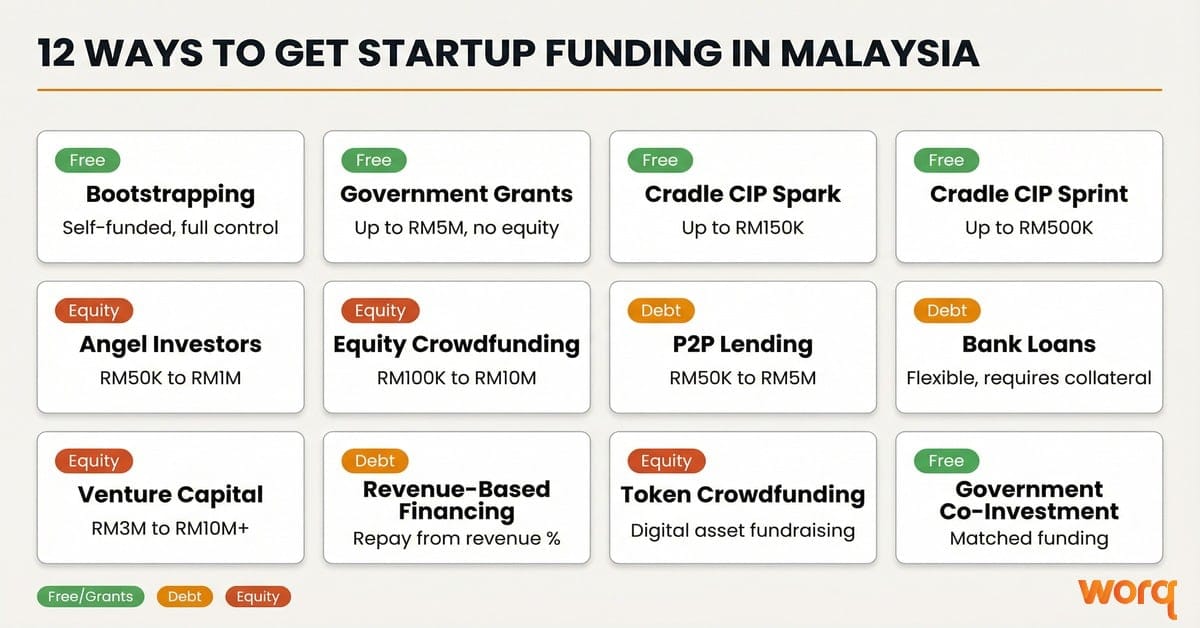
- Malaysia offers at least 12 distinct funding paths for startups, from non-dilutive government grants (Cradle CIP, MDEC, MTDC) to equity-based options like venture capital and crowdfunding, plus newer channels like token crowdfunding and revenue-based financing. Each option suits a different stage.
- As of mid-2025, over RM10 billion has been raised through equity crowdfunding and P2P lending platforms alone, showing that alternative funding channels in Malaysia are mature and well-regulated by the Securities Commission.
- The right funding path depends on your startup’s stage, how much equity you are willing to give up, and whether you need capital, mentorship, or both. Newer options like revenue-based financing and token crowdfunding add flexibility beyond traditional channels. Most founders combine 2 to 3 types across their growth journey.
Startup funding in Malaysia has never had more options than it does right now. Between government grants from agencies like Cradle and MDEC, a growing pool of angel investors and VC firms, and SC-regulated platforms for equity crowdfunding and P2P lending, Malaysian founders can access capital from pre-idea stage all the way to Series A and beyond.
But more options also means more decisions. Each funding type comes with trade-offs: some require you to give up equity, some require repayment, and some come with restrictions on how the money can be used. This guide breaks down 12 practical funding options for Malaysian startups today, explains how each one works, and walks you through the application process step by step.
Table of Contents
1. Government Grants: Up to RM5 Million in Non-Dilutive Funding
2. Angel Investors: RM50K to RM1 Million in Seed-Stage Capital
3. Venture Capital: RM3 Million to RM10 Million+ for Scaling Startups
4. Equity Crowdfunding: RM776 Million Raised Across 404 Campaigns
5. P2P Lending: Over RM10 Billion Raised Through 16 Licensed Platforms
6. Bank Loans and SME Financing
7. Accelerator Programmes: Structured Mentorship Plus Funding
8. Bootstrapping: Full Ownership, Full Control
9. Token Crowdfunding: Raising Capital Through Digital Tokens
10. Revenue-Based Financing: Flexible Repayments Tied to Your Revenue
11. Corporate Venture Capital: Strategic Funding from Large Corporations
12. Build Your Startup with WORQ
13. Frequently Asked Questions
1. Government Grants: Up to RM5 Million in Non-Dilutive Funding
Government grants are free capital. You do not repay them and you do not give up equity. That makes them the most founder-friendly form of funding available.
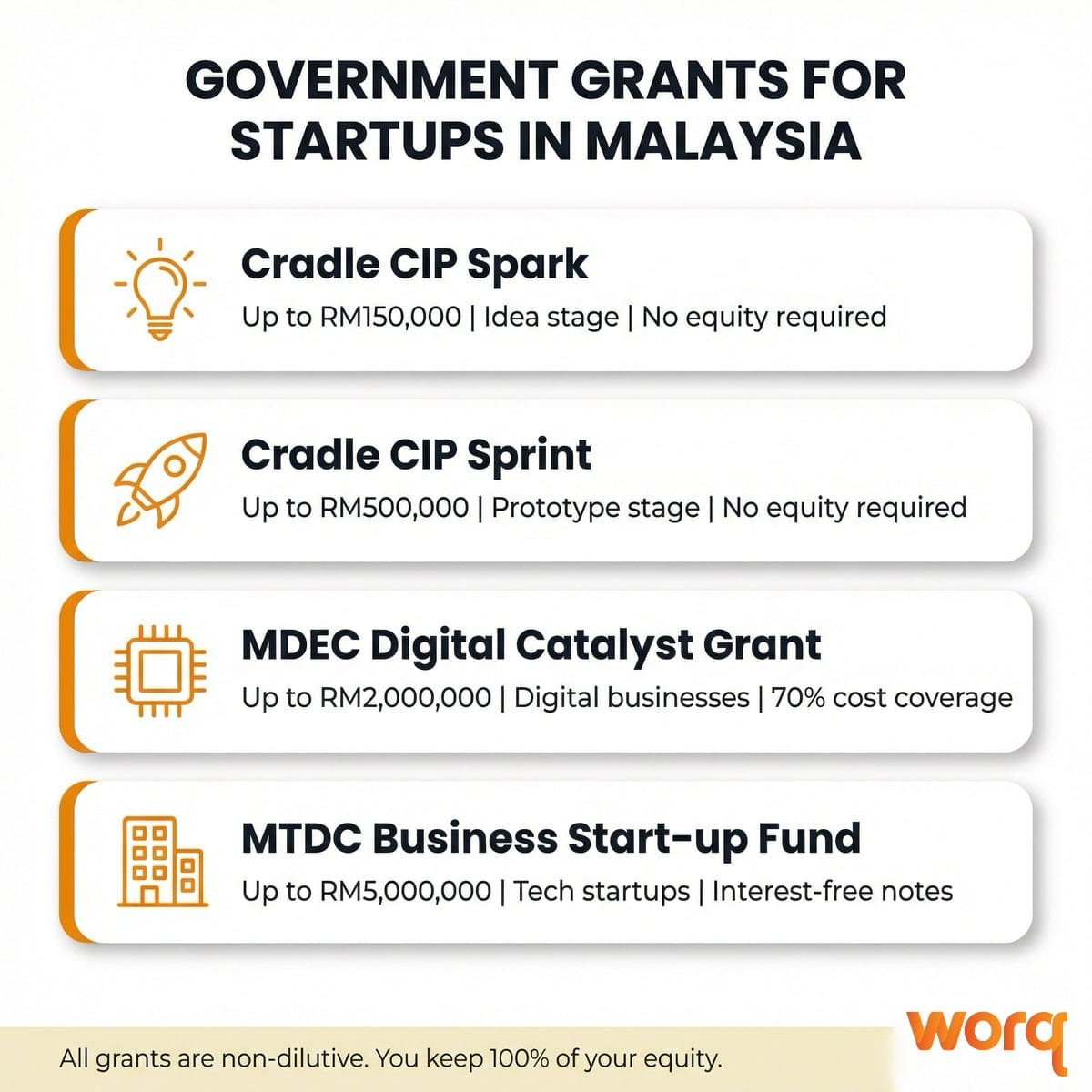
Malaysia has one of the most active grant ecosystems in Southeast Asia for early-stage startups. Key programmes include:
Cradle Fund (CIP Spark and CIP Sprint)
Cradle Fund, under the Ministry of Science, Technology and Innovation (MOSTI), has funded over 1,000 Malaysian tech startups since 2003 and holds the highest commercialization rate among government grants in the country. Their two main programmes:
- CIP Spark: Up to RM150,000 for idea-stage and early validation
- CIP Sprint: Up to RM500,000 for startups with working prototypes or early traction
MDEC (Malaysia Digital Economy Corporation)
MDEC runs several grant programmes targeting digital businesses, including the Malaysia Digital Catalyst Grant and AI-focused grants with funding up to RM2 million (covering up to 70% of project costs).
MTDC (Malaysian Technology Development Corporation)
MTDC’s Business Start-up Fund provides up to RM5 million (or 90% of total project cost) through interest-free Convertible Promissory Notes, with an 18-month grace period and a 5-year repayment window. MTDC has funded and invested in more than 850 Malaysian companies to date.
Budget 2025 and 2026 Tax Incentives
Budget 2025 introduced a 50% additional tax deduction on capacity-building expenses up to MYR500,000. If your startup spends on training, technology adoption, or upskilling, this lowers your tax bill and frees up more cash.
Budget 2026 expanded support further with over RM50 billion in loans and guarantees for entrepreneurs, a RM200 million allocation to the Strategic Co-Investment Fund (CoSIF) for matching capital through ECF and P2P platforms, and a 50% additional tax deduction for MSMEs on certified AI and cybersecurity training programmes.
How to apply: Most government grants require SSM registration, a business plan, and a project proposal. Start with the MYStartup platform for a centralized directory of all national funding agencies and programmes.
For a detailed breakdown of each grant programme and eligibility criteria, read our full guide on startup grants in Malaysia.
2. Angel Investors: RM50K to RM1 Million in Seed-Stage Capital
In general, equity crowdfunding is a method of raising capital and funding from retail investors. It is a way for investors to support SMEs in improving their financial well-being as well as developing strategies based on their experiences. ECF is considered a high-risk investment, but it will have a high return for both investors and SMEs.
“Investors are there to help,” said Khairul Anwar, the CEO & Founder of Pandai. “Investors have the capital to fund businesses as well as the experience to help them thrive,” he elaborated.
Though businesses have multiple investments all over, Angel Low, the principal of the Hive, supported the statement, “Always ask for help from the investors, no matter what area it is.”
How to apply for Equity CrowdFunding (ECF)
1. Choose a platform
There are multiple platforms for ECF. Different platforms have different categories, as there are different types of investors. These investors will most likely have their “go-to” platforms. Different models are reward- or equity-based.
2. Get into the platform
The platform will verify your documents and the forms you submit. If the equity model is what you want to opt for, you have to provide an offer document since it will give the specifics of what the investors are investing in.
3. Pitch your idea
After being accepted, you are given the chance to express your project and how much you are expecting to raise. Before pitching your idea, Khairul advised, “Learn how the investors communicate or interact. Ask the portfolio company about their experience with the investor.” This will give businesses a general idea of how to persuade the investor.
4. Start a campaign
Different platforms have different methods. Some sites will raise your funds during the campaign, while others require you to decide on a goal and receive the funds after achieving it.
Angel investors are individuals who invest personal money into early-stage startups, typically between RM50,000 and RM1,000,000 per deal in Malaysia. They come in at pre-seed or seed stage, often before the startup has meaningful revenue.
Beyond capital, angels bring direct entrepreneurial experience and personal networks. Many have built companies themselves, which means they understand the early-stage grind in ways that institutional investors may not.
Where to find angel investors in Malaysia
- MBAN (Malaysian Business Angel Network): The official trade association and governing body for angel investors in Malaysia. MBAN accredits individual angel investors and angel clubs, and administers the Angel Tax Incentive (ATI), which gives investors a tax deduction for backing certified early-stage startups.
- NEXEA Angel Network: One of the most active networks, with 60+ investor-mentors who are successful entrepreneurs, CEOs, and board members. Initial investment ranges from RM50,000 to RM1,000,000.
- Angel Investment Network Malaysia: An online platform connecting founders with angels across a wide range of industries and stages.
How to apply: Build a clear startup pitch deck with your problem, solution, traction, and ask. Attend startup community events run by NEXEA, Cradle, and MaGIC to build relationships. Register your startup as a Certified Investee Company through MBAN to unlock the Angel Tax Incentive for your investors.
For a deeper breakdown of how angel investing and VC funding work in Malaysia, read our guide on venture capital and angel investors for startups.
3. Venture Capital: RM3 Million to RM10 Million+ for Scaling Startups
Venture capital firms invest pooled institutional money into high-growth startups in exchange for equity. In Malaysia, VC deals typically range from RM3 million to RM10 million, targeting startups at Series A and beyond.
VC funding is not just capital. Firms like NEXEA, Cradle Seed Ventures, 1337 Ventures, and 500 Global provide board-level guidance, hiring support, network access to customers and partners, and credibility that helps attract future investors.
Over the past decade, Malaysia recorded around US$2.1 billion deployed across all venture stages. In 2025, total equity funding reached USD 257 million across 40 deals. The market is consolidating around fewer, larger rounds, which makes preparation and positioning more important than ever.
A key development for 2026: Jelawang Capital, the national fund-of-funds under Khazanah’s Dana Impak (formerly MAVCAP and Penjana Kapital), now serves as the consolidated government VC vehicle. Combined with KWAP’s Dana Perintis, the total government-linked VC allocation has been increased to RM750 million under Budget 2026.
The trade-off: VC firms take an ownership stake and often a board seat. You gain capital and strategic support, but you give up a portion of control and decision-making.
How to apply: Get your financials, pitch deck, and traction data ready. Target 20 to 30 firms that invest in your sector and stage. Use warm introductions from portfolio founders or ecosystem participants. Expect 3 to 6 months from first meeting to term sheet.
4. Equity Crowdfunding: RM776 Million Raised Across 404 Campaigns
Equity crowdfunding (ECF) lets you raise capital by selling shares in your company to a pool of investors through a regulated online platform. Malaysia was the first country in Asia-Pacific to regulate ECF back in 2015, and the market has matured quickly since.
As of end 2024, Malaysian ECF platforms had raised a cumulative RM776.15 million across 404 campaigns. pitchIN, the most established platform, has processed over RM350 million from 18,000+ investors.
Key facts about ECF in Malaysia
- Lifetime fundraising cap: RM20 million per issuer
- Regulated by: Securities Commission Malaysia
- Open to: Retail, angel, and sophisticated investors (each with different annual limits)
- Campaign duration: Typically 30 to 60 days
- SC-registered platforms: pitchIN, Ata Plus, Leet Capital, and MyStartr
ECF gives you more than just capital. A successful campaign builds a community of investor-advocates, creates public market validation, and generates visibility for your brand.
How to apply: Choose an SC-registered platform, submit your business documents for due diligence (2 to 4 weeks), prepare a pitch video and campaign page, then launch. A strong day-one push from your existing network is what creates momentum for outside investors.
For a full breakdown of ECF rules, platforms, and preparation steps, read our guide on equity crowdfunding and P2P lending for startups in Malaysia.
5. P2P Lending: Over RM10 Billion Raised Through 16 Licensed Platforms
Peer-to-peer (P2P) lending connects your business directly with individual lenders through an online platform. You borrow money and repay it with interest over a fixed term. No equity changes hands.
The P2P market in Malaysia is substantial. As of mid-2025, over RM10 billion in total funding has been raised through ECF and P2P platforms combined, benefiting over 23,000 businesses. There are 16 licensed P2P operators registered with the Securities Commission.
When P2P lending makes sense
- You need working capital or bridge financing quickly
- You have predictable cash flow to service loan repayments
- You do not want to give up equity
- You need invoice financing for outstanding receivables
Licensed platforms include: Funding Societies, MicroLEAP, and Capsphere.
How to apply: Register on a platform, submit your SSM registration and 3 to 6 months of bank statements, complete the credit assessment, and receive funds within days to 2 weeks of approval.
6. Bank Loans and SME Financing
Traditional bank financing is still available, and Malaysia has several programmes that make it easier for startups and SMEs to qualify.
- CGC (Credit Guarantee Corporation): Provides guarantee schemes like BizMula-i and BizWanita-i that help SMEs access bank financing even without sufficient collateral.
- SME Bank: Offers financing packages tailored to small businesses, including micro-financing from as low as RM50,000.
- BSN (Bank Simpanan Nasional): Runs the TEKUN Nasional micro-credit programme for small business owners and entrepreneurs.
Bank loans require repayment with interest, and approval processes tend to be slower than alternative platforms. But interest rates are generally lower than P2P lending, and you retain full ownership.
How to apply: Prepare your business plan, financial statements, and collateral documentation. Check CGC’s guarantee schemes first to improve your approval chances if you lack collateral.
7. Accelerator Programmes: Structured Mentorship Plus Funding
Accelerator programmes provide structured support, mentorship, and sometimes direct funding in exchange for a small equity stake (typically 3% to 8%).
Active programmes in Malaysia:
- MYStartup Accelerator: Government-backed, offering up to RM1,000,000 in grants and funding
- Alpha Startups by 1337 Ventures: Focused on idea and MVP-stage founders with structured validation and investor access
- NEXEA Accelerator: Combines funding with mentorship from 60+ investor-mentors
- Supercharger by Standard Chartered: Fintech-focused accelerator with banking industry connections
These programmes work well for founders who need structured guidance alongside capital. The equity cost is small compared to a typical angel or VC round, and the mentorship can accelerate your progress by months.
How to apply: Check each programme’s intake cycle (most run 1 to 2 cohorts per year). Applications typically require a pitch deck, team background, and product or traction summary.
8. Bootstrapping: Full Ownership, Full Control
Bootstrapping means funding your startup from personal savings, early customer revenue, or both. It is the most common starting point for Malaysian founders, and it comes with one clear advantage: you keep 100% ownership and full decision-making control.
The trade-off is speed. Without external capital, growth depends on how fast you can generate and reinvest revenue. But for service-based startups, consulting firms, and SaaS products with low upfront costs, bootstrapping can be the smartest path.
Practical ways to bootstrap in Malaysia:
- Start lean. Keep overhead low by using flexible workspaces and shared infrastructure instead of committing to a long-term office lease. We offer private offices and hot desks starting from day passes, so you can scale your workspace as your team grows.
- Validate before building. Use pre-sales, waitlists, or pilot programmes to confirm demand before investing heavily in product development.
- Use free government resources. MYStartup and MaGIC offer free advisory, workshops, and networking without any funding commitment required.
9. Token Crowdfunding: Raising Capital Through Digital Tokens
Token crowdfunding (TCF) lets you raise capital by issuing digital tokens to investors through a regulated platform. It sits alongside equity crowdfunding under the Securities Commission Malaysia’s regulatory framework, but uses blockchain-based tokens instead of traditional shares.
TCF offers several advantages over ECF. Token holders can potentially trade their tokens on secondary markets, which gives investors more liquidity and can make your campaign more attractive. It also opens your raise to a broader investor base familiar with digital assets.
SC-registered TCF platforms
- pitchIN: One of two licensed TCF operators in Malaysia, already established as the leading ECF platform
- Ata Plus: Also registered to facilitate token crowdfunding alongside ECF campaigns
When TCF makes sense
- You are building a product or platform with a digital-native user base
- You want to offer investors more liquidity than traditional ECF shares
- Your business model aligns with token utility (e.g., platform credits, access rights, or digital goods)
How to apply: The process mirrors ECF. Submit your business for due diligence through an SC-registered platform, prepare your campaign materials, and launch. TCF campaigns follow the same issuer limits and investor protections as ECF under the SC’s Guidelines on Digital Assets.
10. Revenue-Based Financing: Flexible Repayments Tied to Your Revenue
Revenue-based financing (RBF) provides capital upfront in exchange for a fixed percentage of your monthly revenue until the total repayment amount is reached. Unlike a bank loan, there are no fixed monthly installments. If your revenue dips, your repayment drops with it.
RBF sits between debt and equity. You do not give up ownership, and you do not commit to rigid monthly payments. This makes it particularly suited to startups with recurring revenue, subscription models, or seasonal cash flow.
In mid-2025, Dattel Asia Group launched a RM50 million RBF programme specifically for Malaysian MSMEs, in collaboration with OHSEM360. This signals growing institutional support for RBF as a mainstream funding channel in Malaysia.
When RBF makes sense
- You have consistent monthly revenue but it fluctuates seasonally
- You want growth capital without equity dilution or fixed loan repayments
- Your business runs on subscriptions, retainers, or recurring contracts
How to apply: RBF providers typically require 3 to 6 months of revenue history and access to your financial data (bank statements, payment processor records). Approval and disbursement can happen within 1 to 2 weeks.
11. Corporate Venture Capital: Strategic Funding from Large Corporations
Corporate venture capital (CVC) involves large corporations investing directly in startups for both financial returns and strategic alignment. Unlike traditional VC firms, corporate investors bring direct access to their distribution channels, customer base, and industry expertise.
Active CVC programmes in Malaysia
- Sunway iLabs Ventures: The CVC arm of Sunway Group, investing in regional tech startups with access to Sunway’s ecosystem
- Petronas Ventures: Invests in energy technology and sustainability startups aligned with Petronas’ strategic priorities
- Khazanah Nasional: Malaysia’s sovereign wealth fund invests in high-growth sectors through its Dana Impak initiative
The trade-off: CVC investors often expect strategic alignment with their core business. This can be a major advantage if your product fits their ecosystem, but it may limit your flexibility to pivot or partner with competitors.
How to apply: CVC deals are typically sourced through ecosystem events, accelerator programmes, and direct outreach. Build relationships with corporate innovation teams at events like WORQ pitch sessions, MaGIC programmes, and industry-specific conferences.
12. Government Co-Investment Funds: Matching Capital for ECF and P2P Campaigns
Government co-investment funds provide matching capital alongside private investors on ECF and P2P platforms. This reduces risk for both founders and investors, and can significantly boost the momentum of a crowdfunding campaign.
Key programmes
- Strategic Co-Investment Fund (CoSIF): Allocated RM200 million under Budget 2026, CoSIF matches private investments made through SC-registered ECF and P2P platforms. pitchIN operates as a partner platform for CoSIF deployment.
- Malaysia Co-Investment Fund (MyCIF): Provides matching grants through approved alternative financing platforms, helping startups reach their funding targets faster.
Why co-investment funds matter
If you raise RM500,000 through an ECF campaign on pitchIN, a co-investment match can add RM250,000 to RM500,000 in additional capital without further dilution beyond what you already committed to. This makes your campaign more attractive to private investors, who see reduced risk through government participation.
How to apply: Co-investment matching is typically facilitated through the ECF or P2P platform itself. When you launch a campaign on a participating platform, the co-investment fund evaluates your campaign alongside the platform’s due diligence. No separate application is usually required.
How to Choose the Right Funding Option
There is no single best funding path. The right option depends on your startup’s stage, growth speed, and how much control you want to keep.
| Funding Type | Typical Amount | Equity Required | Timeline | Best For |
|---|---|---|---|---|
| Government Grants | RM150K to RM5M | None | 4 to 12 weeks | Idea to prototype stage |
| Angel Investors | RM50K to RM1M | Yes (10 to 20%) | 4 to 8 weeks | Pre-seed and seed stage |
| Venture Capital | RM3M to RM10M+ | Yes (15 to 30%) | 3 to 6 months | Series A and scaling |
| Equity Crowdfunding | Up to RM20M lifetime | Yes (varies) | 30 to 60 days | Early to growth stage |
| P2P Lending | RM50K to RM10M | None | Days to 2 weeks | Working capital and bridge financing |
| Bank Loans | RM50K to millions | None | 2 to 8 weeks | Established businesses with collateral |
| Accelerators | Up to RM1M | Yes (3 to 8%) | Cohort-based | Idea to MVP stage |
| Bootstrapping | Self-funded | None | Immediate | Any stage, full control |
| Token Crowdfunding | Up to RM20M lifetime | Token-based | 30 to 60 days | Digital-native businesses |
| Revenue-Based Financing | Varies | None | 1 to 2 weeks | Recurring revenue businesses |
| Corporate Venture Capital | RM1M to RM10M+ | Yes (varies) | 3 to 6 months | Strategic fit with corporate partner |
| Co-Investment Funds | Matching capital | Via ECF/P2P | With campaign | ECF and P2P campaigns |
If you are pre-revenue with just an idea:
Start with government grants (Cradle CIP Spark) and bootstrapping. If you need more, approach angel investors.
If you have a working product and early traction:
Consider angel investors or equity crowdfunding for growth capital. P2P lending works if you need short-term working capital without giving up equity.
If you are scaling and need RM3 million or more:
Venture capital is the most common path at this stage. Prepare your pitch deck, financials, and traction data. Our guide on writing a startup pitch deck in Malaysia covers exactly what investors expect to see.
If you have recurring revenue and want flexible capital:
Revenue-based financing lets you repay as a percentage of monthly revenue with no equity dilution. P2P lending also works for short-term needs.
If you want to keep full ownership:
Stick with grants, P2P lending, bank loans, and revenue-based financing. These options do not require giving up equity.
If you are running an ECF or P2P campaign:
Check whether your platform participates in government co-investment programmes like CoSIF. Matching capital can significantly boost your raise without additional dilution.
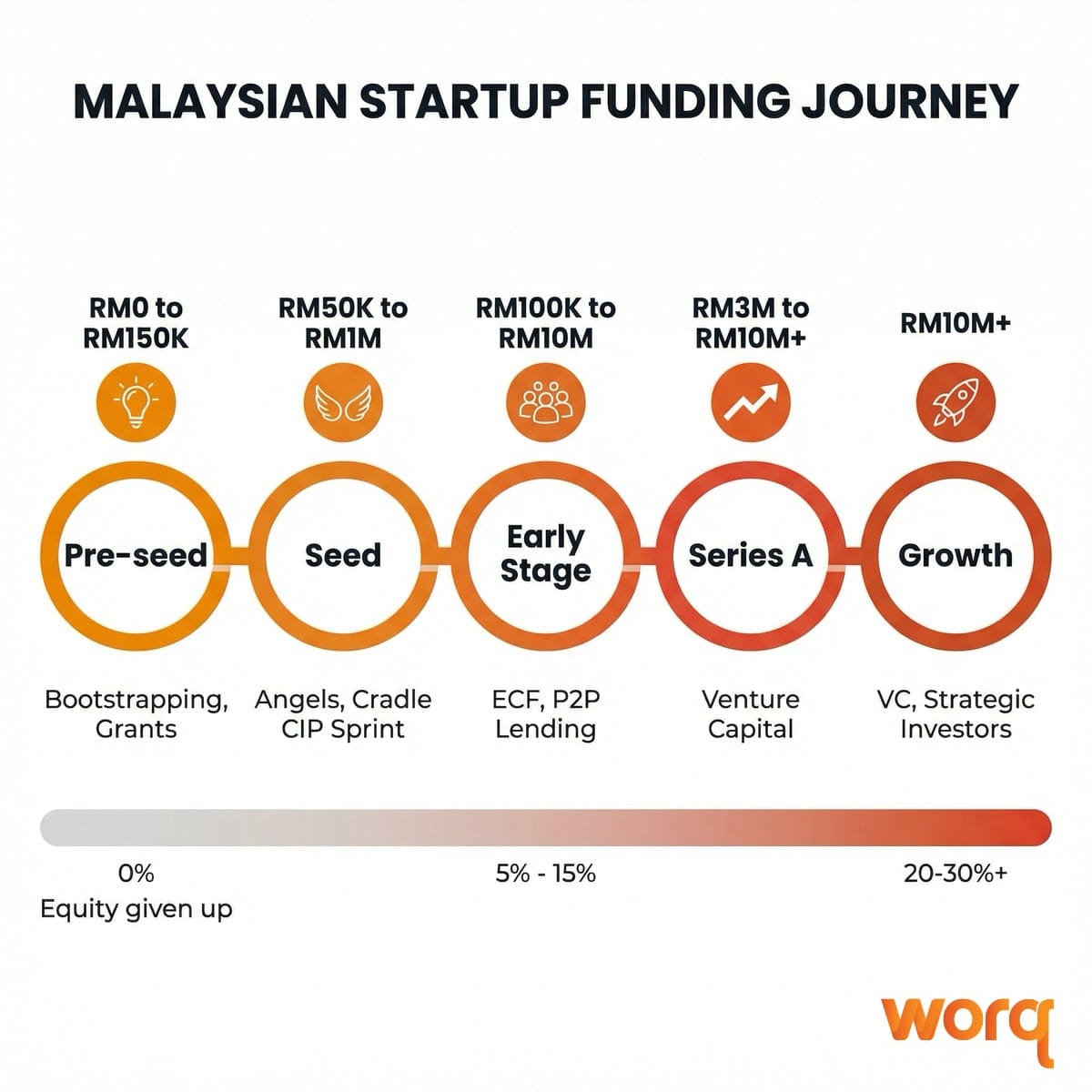
Most Malaysian startups combine 2 to 3 funding types across their journey. Government grants fund early validation, angel investors fund the seed stage, and VC or ECF funds the growth stage. Plan your funding strategy across multiple rounds, not as a single decision.
Build Your Startup with WORQ
The right funding gets your startup moving. The right environment keeps it moving.
At WORQ, we have built coworking spaces across Kuala Lumpur specifically for founders and growing teams. Our community includes over 10,000 members, from solo founders to enterprise teams. We run regular startup events, pitch sessions, and networking mixers that connect you with other founders, mentors, and investors.
For early-stage startups watching every ringgit, our office calculator shows you a clear comparison of initial start-up costs and total expenses between a WORQ workspace and a conventional office lease. The difference adds months of runway to your budget.
Bootstrapping, funded, or somewhere in between, you can start with a hot desk and scale to a private office as your team grows. Browse WORQ locations across KL and find the right base for your next stage.
Frequent Asked Questions
-
What is the easiest type of startup funding to get in Malaysia?
Government grants through Cradle Fund’s CIP Spark programme are the most accessible starting point. The application requires a business plan and SSM registration, and the grant of up to RM150,000 does not require repayment or equity. P2P lending is also relatively fast if you have a credit profile and cash flow to support repayments.
Can I raise multiple types of funding at the same time?
Yes. Many Malaysian startups layer funding sources across their growth. For example, you might secure a Cradle grant for early product development, then raise an angel round to scale, while using P2P lending for short-term working capital. The key is making sure your cap table and cash flow can support all commitments.
How long does it take to raise startup funding in Malaysia?
Timelines vary by funding type. Government grants take 4 to 12 weeks for approval. Angel rounds can close in 4 to 8 weeks. VC rounds at Series A typically take 3 to 6 months. ECF campaigns run 30 to 60 days. P2P lending can disburse within days to 2 weeks after approval.
Do I need a pitch deck for every funding type?
A pitch deck is needed for angel investors, VC firms, and ECF campaigns. Government grants typically require a business plan and project proposal instead. Having both documents ready before you start fundraising saves time and shows preparation.
Is Malaysia a good place to build and fund a startup?
Malaysia’s startup ecosystem has grown steadily. The country attracted RM285.2 billion in approved investments during the first nine months of 2025, a 13.2% increase year-on-year. Budget 2026 unlocked over RM50 billion in loans and guarantees, increased government-linked VC allocation to RM750 million, and allocated RM200 million to co-investment funds on ECF and P2P platforms. Combined with the Angel Tax Incentive, regulated alternative financing channels, and the new Investor Pass visa for foreign founders, Malaysia is one of the more founder-friendly markets in Southeast Asia.




 Enjoy exclusive wellness benefits with Atlas Chiropractic & Physiotherapy, supporting desk-bound professionals with evidence-based chiropractic and physiotherapy care.