
Key Takeaways
- Venture capital (VC) and angel investors are the two main sources of private equity funding for startups in Malaysia, each suited to different growth stages and funding sizes.
- Malaysian angel investors typically invest between RM50,000 and RM1,000,000 at pre-seed to seed stage, while VCs invest from RM3 million to RM10 million at Series A and beyond.
- Active VC firms in Malaysia include NEXEA, Cradle Seed Ventures, 1337 Ventures, 500 Global, Gobi Partners, The Hive SEA, and government-linked funds through MAVCAP, MTDC, and Jelawang Capital.
- The Angel Tax Incentive gives accredited investors a tax exemption of up to RM500,000 for backing certified early-stage startups across 9 eligible technology sectors.
- Fintech, AI, and healthtech attract the most VC capital in Malaysia. The country captured 32% of Southeast Asia’s total AI funding (US$759 million) between H2 2024 and H1 2025.
- The typical fundraising process runs 6 steps from pitch deck preparation to closing, taking 1 to 3 months for angel rounds and 3 to 6 months for VC rounds.
- Founders should focus on building traction, preparing a strong pitch deck, and attending startup community events to connect with the right investors.
Venture capital Malaysia startups conversations tend to focus on government grants and crowdfunding first. But for founders who need larger capital, hands-on mentorship, and strategic networks, private equity funding through VCs and angel investors opens a different path altogether.
Southeast Asia’s venture ecosystem raised US$5.4 billion across 461 deals in 2025, one of the lowest deal counts in six years. Within that landscape, Malaysia recorded USD 257 million across 40 deals, up from USD 141 million across 58 deals in 2024. Singapore captured over 60% of regional deal flow, which means Malaysian founders are competing for a narrower slice of available capital. The market is consolidating around fewer but larger rounds, and knowing where to find the right investors matters more than ever. Over the past decade (2016 to 2025), Malaysian VCs deployed a combined US$2.1 billion into startups across the country.
This guide breaks down how VC and angel investing work in Malaysia, who the active players are, what they look for, and how to position your startup for private equity funding. If you are still mapping out all your funding options, start with our complete overview: 8 ways to get startup funding in Malaysia and how to apply.
Table of Contents
- What Is Venture Capital?
- What Are Angel Investors?
- VC vs Angel Investors: Key Differences
- Active Venture Capital Firms in Malaysia
- Angel Investor Networks in Malaysia
- Where VC Money Flows: Top Sectors in Malaysia
- The Fundraising Process: From Pitch to Close
- What Investors Look for in Malaysian Startups
- How to Connect with VCs and Angels in Malaysia
- Choosing the Right Funding Path for Your Startup
- Build Your Startup at WORQ
- Frequently Asked Questions
What Is Venture Capital?
Venture capital is a form of private equity where firms invest pooled funds into high-growth startups in exchange for equity (ownership shares). VC firms raise capital from institutional investors, high-net-worth individuals, and fund-of-funds, then deploy that capital into startups they believe can deliver outsized returns.
In Malaysia, VC investments typically range from RM3 million to RM10 million per deal, although there is no fixed rule. Most VC funding targets startups at Series A and beyond, meaning the company usually has a working product, measurable traction, and a clear path to scaling.
What VCs Provide Beyond Capital
- Strategic mentorship from partners who have built or scaled companies
- Network access to potential customers, partners, and follow-on investors
- Operational support in areas like hiring, financial planning, and market expansion
- Credibility signal that helps attract talent and future funding rounds
The Tradeoff
VC funding is equity financing. You do not repay the investment like a loan. Instead, the VC firm takes an ownership stake in your company and earns a return when the company exits (through acquisition, IPO, or secondary sale). This means giving up a portion of control and decision-making power.
For founders who want to raise capital without giving up equity, government grants for startups in Malaysia offer a non-dilutive alternative worth considering first.
What Are Angel Investors?
Angel investors are individuals who invest their personal money into early-stage startups, typically at the pre-seed or seed stage. In Malaysia, angel investments usually range from RM50,000 to RM1,000,000.
Unlike VCs who manage pooled institutional capital, angels invest their own wealth. They often bring direct entrepreneurial experience and tend to be more hands-on in mentoring founders during the critical early months of building a company.
Angel Tax Incentive (ATI)
Malaysia offers a government-backed incentive to encourage angel investing. Through the Angel Tax Incentive programme administered by MBAN and Cradle Fund, accredited angel investors can claim a tax exemption of up to RM500,000 on statutory income for the year of assessment.
Key ATI requirements:
- Minimum investment: RM5,000 per deal
- Maximum tax exemption: RM500,000 per year of assessment
- Equity cap: The angel investor must not hold more than 30% of the investee company’s total equity
- Eligible sectors: Advanced electronics and IT, telecommunications, healthcare, electro-optics, advanced materials, transportation, value-add services, automation and flexible manufacturing, and emerging technologies
- Investor eligibility: Must be accredited by MBAN as a high-net-worth individual (bank credit report required) or high-income individual (EA form or latest tax return filed with LHDN)
- Accreditation timeline: 21 calendar days from complete submission, with an RM800 membership fee to Cradle Fund
To qualify, the startup must register as a Certified Investee Company under the ATI programme through MBAN. Upon approval by the Ministry of Finance, the angel investor becomes eligible for the tax exemption equivalent to the investment amount.
Active Venture Capital Firms in Malaysia
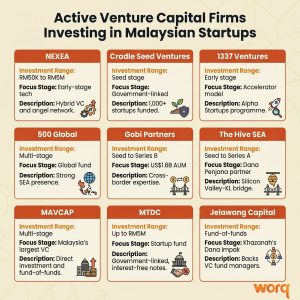
Here are some of the most active VC firms investing in Malaysian startups today.
NEXEA
A hybrid VC and angel investor network that invests in early-stage technology startups across Malaysia and Southeast Asia. NEXEA provides funding between RM50,000 and RM5,000,000, along with access to over 60 investor-mentors who are successful entrepreneurs, CEOs, and board members of listed companies. Their portfolio companies have achieved over 200% year-on-year growth, with more than 50% raising follow-on funding or completing exits.
Cradle Seed Ventures
A subsidiary of Cradle Fund Sdn Bhd, Cradle Seed Ventures focuses on seed-stage investments in technology startups. They also run the CIP Spark grant (up to RM150,000) and CIP Sprint programmes, making them a key player across both grant and equity funding for early-stage companies. To date, Cradle has funded over 1,000 startups in Malaysia.
1337 Ventures
Pronounced “Leet,” 1337 Ventures invests in early-stage startups and runs the Alpha Startups Accelerator to help idea and MVP-stage founders launch, validate, and grow. They also operate Leet Capital, an ECF platform. For founders interested in alternative fundraising methods, equity crowdfunding and P2P lending offer another route to raise capital alongside or instead of VC.
500 Global (formerly 500 Startups)
A global VC firm with a strong Southeast Asia presence. 500 Global has backed multiple Malaysian startups through its regional fund and accelerator programmes. They invest across sectors with a focus on technology-enabled businesses.
Gobi Partners
One of Asia’s most established venture capital firms with over 20 years of investing experience and US$1.6 billion in assets under management. Gobi Partners invests from seed through Series B across Southeast Asia, Central Asia, and the Middle East. For Malaysian founders, Gobi offers cross-border execution expertise and access to a deep regional innovation ecosystem that helps startups navigate regulatory complexity and expand into new markets.
The Hive SEA
An early-stage VC fund and co-creation studio approved under the Dana Penjana Nasional programme. The Hive SEA operates between Silicon Valley and Kuala Lumpur, combining global best practices with strong regional execution. They invest from seed to Series A in tech and tech-adjacent startups, providing hands-on product guidance and support in syndicating future funding rounds.
Government-Linked VC Funds
MAVCAP (Malaysia Venture Capital Management Berhad) is Malaysia’s largest venture capital firm by deployment, founded in 2001 to catalyse the local tech ecosystem. MAVCAP invests directly in startups and also acts as a fund-of-funds, allocating capital to other VC managers. Founders can submit business proposals directly through the MAVCAP website for review.
MTDC (Malaysian Technology Development Corporation) operates both commercial and developmental funds. Their Business Start-up Fund provides up to RM5 million (or 90% of total project cost) through interest-free Convertible Promissory Notes, with an 18-month grace period and 5-year repayment window. MTDC has funded and invested in more than 850 Malaysian companies to date.
Jelawang Capital is Malaysia’s National Fund-of-Funds under Khazanah’s Dana Impak initiative. Rather than investing directly into startups, Jelawang backs credible VC fund managers across borders to strengthen the domestic venture capital pipeline. This structural shift consolidates much of Malaysia’s government-backed VC activity and signals a move toward building a more resilient, self-sustaining venture ecosystem.
2025 VC Tax Incentive
In June 2025, Malaysia introduced a concessionary 5% tax rate for up to 10 years on venture capital funds that invest at least 20% of their capital in Malaysian startups. The incentive broadens investment access through onshore limited liability partnerships and simplifies cross-border fundraising. This policy positions Malaysia as a more competitive regional hub for startup capital and is expected to attract both local and international fund managers.
VC vs Angel Investors: Key Differences
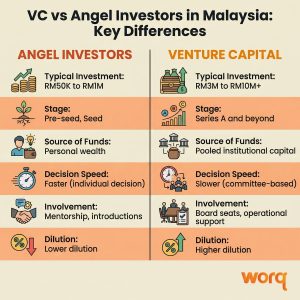
| Angel Investors | Venture Capital | |
|---|---|---|
| Typical investment | RM50K to RM1M | RM3M to RM10M+ |
| Stage | Pre-seed, Seed | Series A and beyond |
| Source of funds | Personal wealth | Pooled institutional capital |
| Decision speed | Faster (individual decision) | Slower (committee-based) |
| Involvement | Mentorship, introductions | Board seats, operational support |
| Dilution | Lower (smaller cheque) | Higher (larger cheque, more control) |
Many startups use angel funding to build their MVP and early traction, then raise a VC round to scale. The two are not mutually exclusive. Angel investors often co-invest alongside VCs in later rounds.
Angel Investor Networks in Malaysia
Malaysian Business Angel Network (MBAN)
MBAN is the official trade association and governing body for angel investors and angel clubs in Malaysia. Founded in 2014 and registered under the Societies Act 1966, MBAN is responsible for:
- Accrediting individual angel investors and angel clubs
- Administering the Angel Tax Incentive programme
- Creating awareness and training for angel investors
- Monitoring angel investment statistics across Malaysia
MBAN’s secretariat operates through Cradle Fund Sdn Bhd, and membership is open to both individual investors and corporate entities.
NEXEA Angel Network
Beyond their VC fund, NEXEA operates one of Malaysia’s most active angel investor networks. Their angel investors are successful entrepreneurs and business owners who provide RM50,000 to RM1,000,000 in initial funding, access to mentors, and partner benefits worth up to RM2,000,000.
Angel Investment Network Malaysia
An online platform connecting Malaysian entrepreneurs with angel investors. Investment ranges on the platform vary from USD 1,000 to USD 1,000,000, covering a wide spectrum of industries and stages.
Where VC Money Flows: Top Sectors in Malaysia
Not all sectors attract equal attention from investors. Understanding where capital concentrates helps founders position their startups within the right narrative.
Fintech remains the most active sector across Southeast Asia, recording 111 transactions totalling US$1.3 billion in 2025. In Malaysia, fintech startups in payments, lending, and digital banking continue to draw both local and international VC interest.
AI and deep tech saw a major surge. Malaysia captured 32% of Southeast Asia’s total AI funding between H2 2024 and H1 2025, equivalent to US$759 million, driven by massive infrastructure expansion and high consumer adoption according to the e-Conomy SEA 2025 report by Google, Temasek, and Bain & Company.
Healthtech rebounded strongly in 2025, with 35 deals and US$393 million in funding across the region. Malaysia’s digital health startups are increasingly attracting cross-border capital.
E-commerce and logistics remain steady investment targets, particularly startups addressing last-mile delivery, cross-border trade, and social commerce in the ASEAN corridor.
IoT and industrial tech are gaining traction as Malaysia pushes its Industry 4.0 agenda. Startups building automation, sensor-based solutions, and smart manufacturing tools are seeing growing interest from both corporate VCs and government-linked funds.
For founders, the takeaway is clear: investors are concentrating capital in sectors with strong digital infrastructure tailwinds and regional scalability.
The Fundraising Process: From Pitch to Close
Understanding the mechanics of raising VC or angel funding helps founders set realistic timelines and avoid common missteps. Here is the typical process.
Step 1: Prepare Your Materials
Before reaching out, have these ready:
- A pitch deck covering your problem, solution, market, traction, team, financials, and ask. See our guide on how to build a startup pitch deck.
- A financial model with 3-year projections, unit economics, and burn rate
- A one-pager or executive summary for cold outreach and introductions
- A data room (Google Drive or DocSend) with your cap table, incorporation documents, key contracts, and any IP documentation
Step 2: Build Your Target List
Identify 30 to 50 investors who match your stage, sector, and geography. Use MYStartup’s directory, AngelList, OpenVC, and the VC firm profiles in this guide. Prioritise investors who have backed companies in your space before.
Step 3: Get Introductions and Pitch
Warm introductions convert at significantly higher rates than cold emails. Reach out to portfolio founders, accelerator alumni, and ecosystem contacts for direct introductions. When you pitch, lead with the problem, not the product.
Step 4: Due Diligence
If an investor is interested after the first or second meeting, they will conduct due diligence. This typically includes:
- Verification of financials and traction claims
- Cap table review
- Legal and IP checks
- Reference calls with customers, partners, or advisors
- Background checks on founding team
For angel investors, this process may take 2 to 4 weeks. For VC firms with investment committees, expect 4 to 12 weeks.
Step 5: Term Sheet and Negotiation
The investor issues a term sheet outlining the proposed investment amount, valuation, equity stake, board seat rights, liquidation preferences, and any special conditions. This is a non-binding agreement that sets the framework for the final deal. Founders should review the term sheet with a lawyer experienced in startup financing before signing.
Step 6: Closing
Once terms are agreed, legal counsel on both sides drafts the shareholders’ agreement and subscription agreement. Funds are transferred upon execution. The full process from first meeting to money in the bank typically takes 3 to 6 months for VC rounds and 1 to 3 months for angel rounds in Malaysia.
What Investors Look for in Malaysian Startups
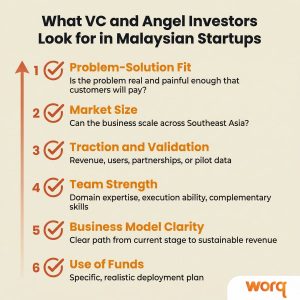
Whether you are pitching to an angel or a VC firm, investors in Malaysia generally evaluate the same core criteria. Getting these right is the foundation of a strong startup pitch deck.
1. Problem-Solution Fit
Is the problem real, specific, and painful enough that customers will pay to solve it? Investors want to see that you understand the problem deeply, not just theoretically.
2. Market Size and Opportunity
How large is the addressable market? For Malaysian startups, investors also want to know if the business can scale regionally across Southeast Asia.
3. Traction and Validation
Revenue, active users, partnerships, or pilot programmes. At pre-seed, this might be customer interviews and waitlists. At Series A, investors expect measurable unit economics and repeatable growth.
4. Team Strength
Investors bet on founders. They look for domain expertise, execution ability, and resilience. A strong founding team with complementary skills is often the deciding factor between two startups with similar products.
5. Business Model Clarity
How does the company make money, and can it scale profitably? Investors want to see a clear path from current stage to sustainable revenue.
6. Use of Funds
A specific, realistic plan for how the investment will be deployed. Vague answers here are a red flag for any investor.
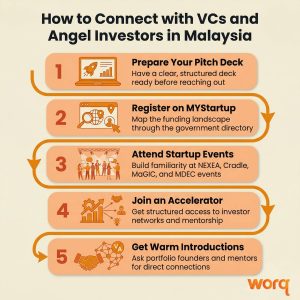
How to Connect with VCs and Angels in Malaysia
Finding investors is not just about sending cold emails. The Malaysian startup ecosystem is relatively small, and relationships matter. Here are practical ways to get connected.
Attend Startup Community Events
Events run by NEXEA, Cradle Fund, MaGIC, and MDEC regularly bring together founders and investors. Most active investors in Malaysia attend 4 to 5 key events per year, and the community is small enough that consistent attendance builds familiarity quickly.
Join Accelerator Programmes
Programmes like NEXEA’s accelerator, Alpha Startups by 1337 Ventures, and the MYStartup Accelerator provide structured access to investor networks, mentorship, and up to RM1,000,000 in grants and funding.
Register on MYStartup
The government’s MYStartup platform (mystartup.gov.my) maintains a centralised directory of national funding agencies, private funding firms, and startup programmes. It is a useful starting point for mapping the full funding landscape.
Get Warm Introductions
Investment relationships in Malaysia are heavily introduction-based. Ask existing portfolio founders, mentors, or ecosystem participants to connect you with the right investors. A warm introduction from a trusted source carries significantly more weight than a cold pitch.
Prepare a Strong Pitch Deck First
Before approaching any investor, make sure your pitch deck is ready. A clear, well-structured deck is your first impression and often determines whether you get a meeting. We put together a detailed guide on how to build a startup pitch deck that works for Malaysian investors.
Choosing the Right Funding Path for Your Startup
Private equity funding is not the right fit for every startup. Before pursuing VC or angel investment, consider these questions:
Do you need capital, mentorship, or both? Angels offer more personal mentorship and faster decisions. VCs offer larger capital and operational infrastructure.
What stage is your startup at? Pre-revenue founders are better suited to angel rounds or government grants. Post-traction companies with clear unit economics are better positioned for VC.
Are you comfortable with dilution? Both angels and VCs take equity. If retaining full ownership is important right now, non-dilutive options like grants should come first.
Have you considered alternative fundraising? Equity crowdfunding and P2P lending have raised over RM10 billion combined in Malaysia and offer a middle ground between grants and private equity.
For a complete overview of every funding option available to Malaysian startups, read our pillar guide: 12 ways to get startup funding in Malaysia and how to apply.
Build Your Startup at WORQ
Securing funding is one piece of the puzzle. Having the right workspace and community around you speeds up everything else.
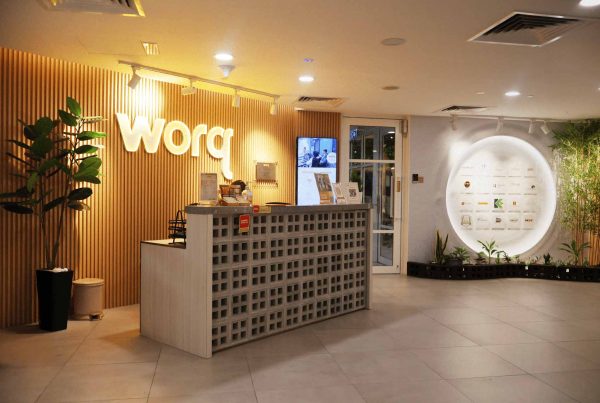
At WORQ, we bring together founders, investors, and business leaders under one roof. Our coworking spaces across Kuala Lumpur give your startup the environment it needs to grow, from networking events to day-to-day collaboration with other founders who are building alongside you.
Whether you need a hot desk to get started or a private office for your growing team, we have flexible options that fit your stage. Use our office space calculator to find the right setup, and check out WORQ locations to pick a base for your next chapter.
Frequently Asked Questions
What is the difference between a venture capitalist and an angel investor in Malaysia?
Angel investors use personal funds to invest smaller amounts (RM50K to RM1M) at the earliest stages, while venture capitalists manage pooled institutional funds and invest larger amounts (RM3M to RM10M or more) at Series A and beyond. Angels typically make faster individual decisions, while VCs follow committee-based evaluation processes.
How do I find angel investors in Malaysia?
Start by registering with MBAN (Malaysian Business Angel Network) and attending startup events organized by NEXEA, Cradle Fund, and MaGIC. Online platforms like Angel Investment Network Malaysia also connect founders with investors. Building relationships through the startup community is the most effective long-term approach.
What is the Angel Tax Incentive in Malaysia?
The Angel Tax Incentive (ATI) is a government programme that gives accredited angel investors a tax deduction for investing in certified early-stage startups. It is administered by MBAN and Cradle Fund. Startups must register as Certified Investee Companies to qualify.
How much equity should I give up in a seed round?
There is no fixed rule, but Malaysian seed rounds typically involve giving up 10% to 25% equity depending on the valuation, investment amount, and negotiation. The key is to retain enough equity to stay motivated and attract future rounds without over-diluting early.
Can I raise both grant funding and VC investment at the same time?
Yes. Many Malaysian startups use non-dilutive grants (such as Cradle CIP Spark or MDEC grants) to fund early development, then raise angel or VC capital for scaling. The two are complementary, and having grant funding on your track record can signal credibility to private investors.
How long does it take to raise VC funding in Malaysia?
The timeline varies by investor type and round size. Angel rounds typically close in 1 to 3 months from first meeting to funds received. VC rounds with investment committee processes take 3 to 6 months on average. The due diligence phase alone can take 4 to 12 weeks for institutional VCs. Founders should plan their runway accordingly and start fundraising well before they need the capital.
What is a term sheet?
A term sheet is a non-binding document issued by an investor that outlines the key terms of a proposed investment. It typically covers the investment amount, pre-money valuation, equity stake, board seat rights, liquidation preferences, anti-dilution protections, and any special conditions. It sets the framework for the final shareholders’ agreement and subscription agreement that follow during closing.
What is the difference between venture capital and private equity in Malaysia?
Venture capital is a subset of private equity that focuses on early-stage, high-growth startups. Traditional private equity firms typically invest in more mature companies, often taking majority stakes and restructuring operations. In Malaysia, VC firms like NEXEA and Gobi Partners target startups from seed to Series B, while private equity firms focus on established businesses with proven revenue and profitability.
What sectors do VCs invest in most in Malaysia?
Fintech leads in deal volume, followed by AI and deep tech, healthtech, e-commerce and logistics, and IoT. Malaysia captured 32% of Southeast Asia’s total AI funding between H2 2024 and H1 2025, equivalent to US$759 million. Government policy tailwinds around Industry 4.0, digital banking, and the halal economy are also creating new investment verticals.




 Enjoy exclusive wellness benefits with Atlas Chiropractic & Physiotherapy, supporting desk-bound professionals with evidence-based chiropractic and physiotherapy care.