
Key Takeaways
- Startup grants in Malaysia open and close at different times. On 16 November 2026, MDEC’s MDXG, MDAG-AI and Digital Content Grant pages showed applications closed, MDCG showed an Apply Now button that depends on available funds, and Cradle’s CIP pages published no intake dates.
- “Grant” does not always mean free money. Cradle’s CIP grants carry payback terms on termination, the DCG Mega Grant takes a 10% share of net sales for three years, some NTIS funding converts or is repayable, and MTDC’s Business Start-up Fund is financing with a repayment period.
- Several programmes reimburse approved costs after you spend, and their timing rules differ. MDEC’s MDCG and MDXG and MRANTI’s Dana Pengkomersialan do not cover work started before approval, while MATRADE’s MDG is claimed after the activity. Check each programme’s rules before you commit spending, and plan the cash to front costs until claims are paid.
Startup grants in Malaysia can pay for a prototype, an export push or your first interns, but only if you pick a programme that is open, fits your company’s age and ownership, and pays out on terms your cash flow can handle. We checked every programme in this guide against its official page on 16 November 2026, and we flag which ones were open, which were closed and which publish no fixed intake window.
We also sort each programme by what you may owe back. Some are straightforward reimbursable grants. Others are conditional grants, revenue-sharing grants, convertible funding or financing with a grace period. If you want the wider picture beyond grants, including angel investors, crowdfunding and bank loans, our guide to startup funding in Malaysia covers all the main routes.
Startup Grants in Malaysia at a Glance: Status Checked 16 November 2026
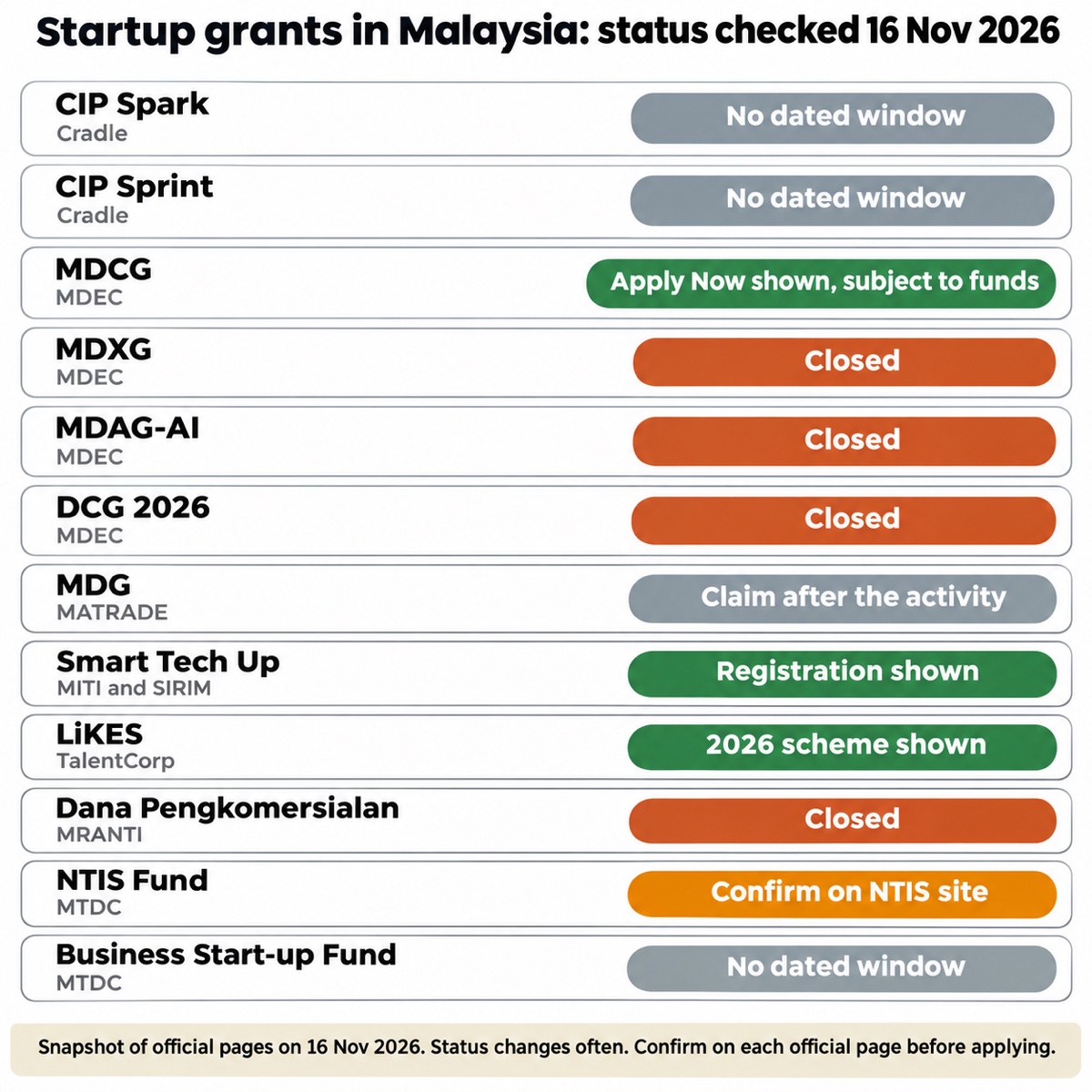
Use this table as a shortlist, then open the official page before you start writing. “No dated window” means the programme page is live but does not publish intake dates. A status can change at any time, so treat each one as a snapshot of that date.
| Programme | Agency | What you may owe back | Headline amount | Status on 16 Nov 2026 |
|---|---|---|---|---|
| CIP Spark | Cradle | Conditional grant, payback on termination and other agreement terms | Up to RM150,000 | No dated window, apply through Cradle’s Grant Management System |
| CIP Sprint | Cradle | Conditional convertible commercialisation grant | Up to RM600,000 | No dated window, apply through Cradle’s Grant Management System |
| MDCG | MDEC | Co-funding grant, reimbursed against deliverables | Up to 50% of cost (30% if majority foreign-owned), max RM1 million | Apply Now shown, subject to available funds |
| MDXG | MDEC | Co-funding grant, reimbursed against deliverables | Up to 50% of cost (30% if majority foreign-owned), max RM1 million | Application closed |
| MDAG-AI | MDEC | Performance-based reimbursement | Up to 70% of cost, max RM2 million | Application closed (window was 8 to 18 July 2025) |
| DCG 2026 | MDEC | Mega Grant has a 10% net sales revenue share for 3 years | Up to RM2 million (Mega), RM300,000 (Marketing and Commercialisation) | Application closed (window was 15 July to 30 September 2026) |
| MDG | MATRADE | Reimbursable grant | RM300,000 lifetime limit | Claims through the MADANI Digital Trade Platform within 30 calendar days after the event, first listing day or certification approval, subject to government funds |
| Smart Tech Up | MITI with SIRIM | Matching assistance, you fund the other half | 50% of cost, max RM500,000 | Registration shown on portal |
| LiKES | TalentCorp | Advance grant and pay-and-claim matching grant | RM2,000 advance per intern and/or 50% of allowance up to RM850 a month | 2026 scheme and registration route shown |
| Dana Pengkomersialan | MRANTI | Commercialisation funding, terms in the guideline | Up to RM1 million per project | Applications closed |
| NTIS Fund | MTDC | Convertible grant, or hybrid grant plus repayable notes, by scheme | Caps from RM500,000 to RM4 million, depending on scheme | MTDC says applications are open on the NTIS website, which did not load when we checked |
| Business Start-up Fund | MTDC | Repayable, interest-free convertible notes or preference shares | Up to RM5 million or 90% of cost, whichever is lower | No dated window, pitch or register interest |
Grant, Conditional Grant or Financing? What You May Have to Pay Back
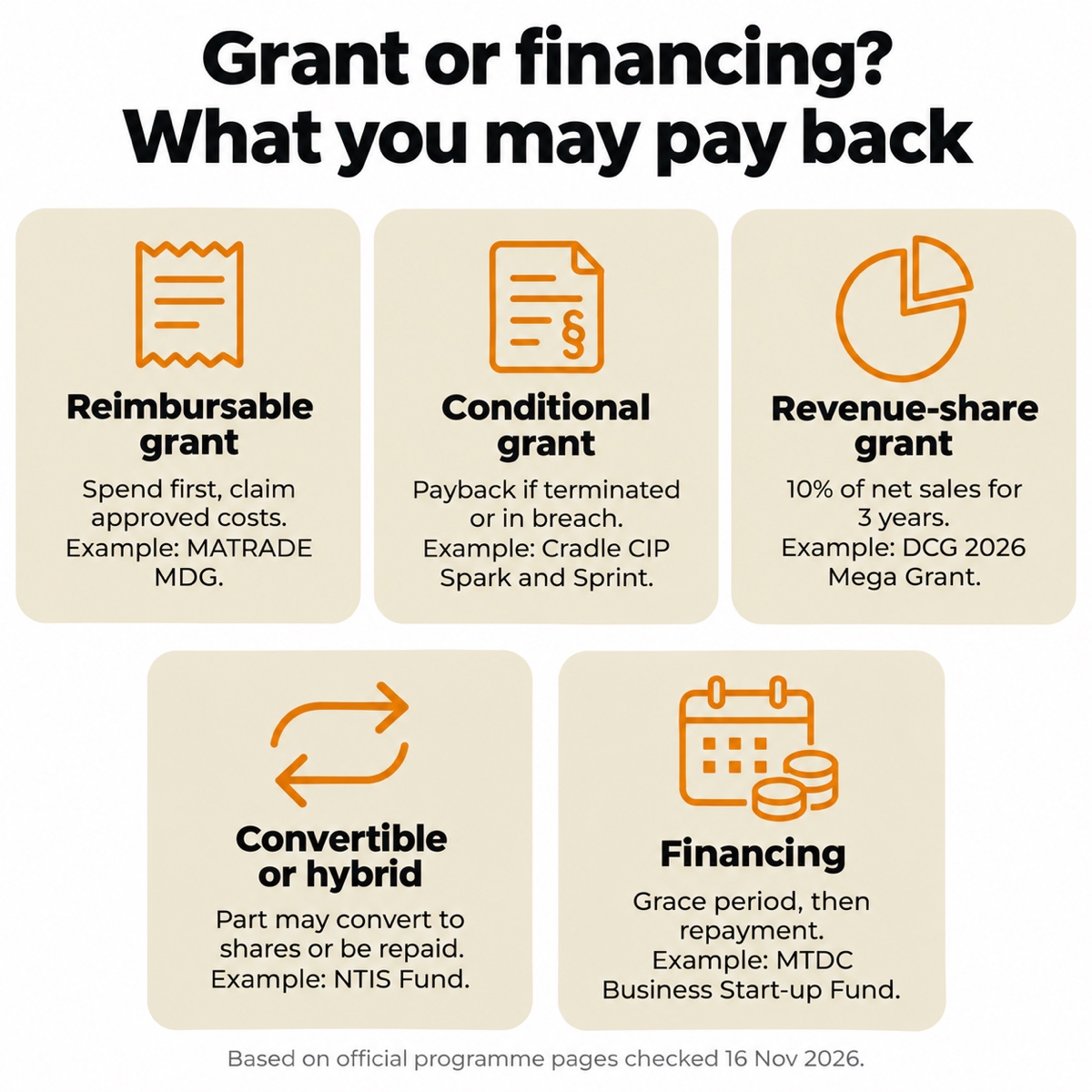
Many grant lists treat every programme as free money. The official terms tell a more useful story. Here is how the programmes in this guide fall into five groups.
- Reimbursable grants. You spend first, claim approved costs and keep what is approved, as long as you meet the terms. MATRADE’s MDG and the DCG Marketing and Commercialisation Grant fit here.
- Conditional grants. You can be asked to return money if the agreement is terminated or breached. Cradle states this directly for CIP Spark and CIP Sprint, and MDEC’s DCG terms allow a clawback of the full amount disbursed after a breach or termination.
- Revenue-sharing grants. The DCG 2026 Mega Grant asks recipients to share 10% of net sales revenue for three years after the project ends.
- Convertible and hybrid funding. Some NTIS schemes allow up to 20% of the funding to convert into redeemable convertible preference shares on success triggers, and the Commercialisation Sandbox mixes grant money with notes repayable over four years.
- Financing. MTDC’s Business Start-up Fund has an 18-month grace period and a five-year repayment period. MDV finances startups that already have venture capital backing. Both are useful, but neither is a grant.
Ask one question before you shortlist anything: if this project fails or slips, what would we owe?
Cradle CIP Spark and CIP Sprint: Up to RM150,000 and RM600,000
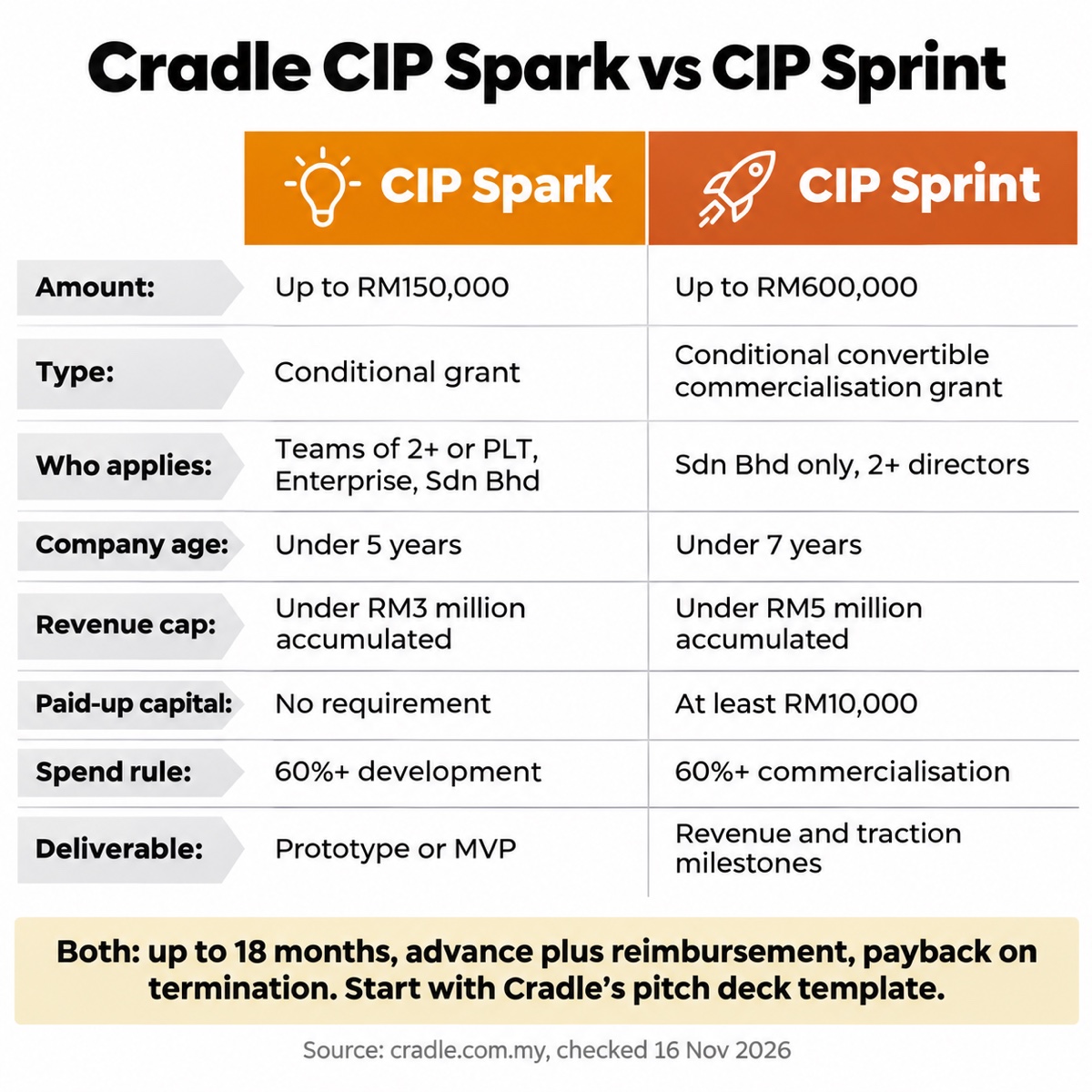
Cradle runs the two programmes most early tech founders look at first. Both last up to 18 months, both pay through advance payments and reimbursements, and both make milestone delivery a condition for the next payment. Any unused amount is deducted from your next advance.
You do not need a full document pack to apply. Cradle’s FAQ says you start with a pitch deck on its template, and other verification documents come only after shortlisting. That makes your deck the real first filter, so it is worth getting the structure right. Our guide to building a startup pitch deck in Malaysia walks through the slides evaluators and investors expect.
Cradle estimates two to four months from pitching to approval, provided your documents are complete. Applications go through its Grant Management System. The public programme pages did not show dated intake windows when we checked.
CIP Spark: Pre-Seed Grant for Teams and Young Companies
- Amount: up to RM150,000, conditional grant
- Who can apply: individuals (a team of at least two, with at least one Malaysian and at least one person living in Malaysia) or companies, including PLT, Enterprise and Sdn Bhd
- Company limits: under 5 years since incorporation, accumulated revenue under RM3 million, own the IP or hold an exclusive licence to it, no other company holding 25% or more, and no paid-up capital requirement
- Use of funds: at least 60% on development, up to 40% on other costs including commercialisation
- What you deliver: at least a functional prototype or MVP by the end of the funding period, plus a demo session and progress reports
CIP Sprint: Commercialisation Grant for Sdn Bhd Companies
- Amount: up to RM600,000, conditional convertible commercialisation grant
- Who can apply: Sdn Bhd only, with at least two directors (at least one Malaysian and at least one living in Malaysia)
- Company limits: under 7 years old, accumulated revenue under RM5 million, paid-up capital of at least RM10,000, IP rights and no company holding 25% or more
- Use of funds: at least 60% on commercialisation, up to 40% on product development or improvement
- What you deliver: revenue and traction milestones during the funding period, so bring traction data with your application
For both programmes, a company with less than 51% Malaysian ownership needs a majority of Malaysian employees. Companies older than 18 months verify revenue with audited accounts.
MDEC Grants for Digital Companies: One Showing Apply Now, Three Closed
MDEC’s grants suit companies with Malaysia Digital (MD) or MSC Malaysia status. MDCG and MDXG share the same core company tests: incorporated in Malaysia, at least one year in operation, and issued share capital of at least RM50,000 with 51% Malaysian equity, or RM500,000 for a majority foreign-owned company. The MDCG and MDXG pages also bar reimbursement for projects that started before approval, so do not begin that work early and hope to claim it back.
MDCG: Up to RM1 Million to Build a Solution With an End User
The Malaysia Digital Catalyst Grant funds co-creation, development and commercialisation of a solution with an end-user partner. You must have no ownership link to that end user, and your application needs a signed agreement, MOU, LOI or purchase order showing the partner will fund its share or support the project.
- Locally owned companies: up to 50% of project cost, capped at RM1 million
- Majority foreign-owned companies: up to 30%, capped at RM1 million
- Project period of up to one year, with new IP or commercial value as the expected result
- Outsourced work capped at 20% of the grant amount requested
MDEC reimburses approved costs as you complete each deliverable, and each claim must be verified by an independent external auditor that you appoint at your own cost. The page showed Apply Now on 16 November 2026. Its FAQ says the grant opened on 9 September 2024 and stays available “subject to the availability of funds”, so a live button is not a promise that money remains.
MDXG and MDAG-AI: Closed When We Checked
The Malaysia Digital X-Port Grant supports export-ready tech companies with the same 50% or 30% share and RM1 million ceiling. Its page showed “Application Closed”. Projects must create jobs filled by Malaysians, keep more than half the project team Malaysian and produce export value. Majority foreign-owned applicants must also be headquartered in Malaysia.
MDAG-AI offered up to 70% of cost, capped at RM2 million, for AI companies across the foundation, enabling and application layers. It accepted companies with issued share capital of at least RM50,000 and either MD status or an active MD application. Its window ran from 8 to 18 July 2025, and the page now shows it closed. Keep both on your watchlist rather than in your plan.
Digital Content Grant 2026: New Structure, Window Now Closed
If you last read about DCG a while ago, the 2026 version looks different. MDEC focused it on animation and digital games, with two grant types:
- Mega Grant: up to RM2 million, covering up to 50% of project cost, for projects of up to 24 months, followed by a 10% share of net sales revenue for three years. The other 50% can come from a broadcaster or another private entity, such as a publisher, distributor or investor.
- Marketing and Commercialisation Grant: up to RM300,000, covering 100% of project cost, for up to six months, with no revenue sharing
The 2026 window ran from 15 July to 30 September 2026 and the page now shows it closed. MDEC states that the process takes 40 working days from confirmation of a complete submission to an approval decision. Claims must be verified by an independent external auditor, and the auditor’s fee is claimable up to RM5,000. Content fully generated by AI is not eligible.
Export, Manufacturing and Hiring Support
These three programmes are not limited to tech startups, which makes them easy to overlook.
MATRADE MDG: RM300,000 Lifetime Limit for Export Promotion
MATRADE describes the Market Development Grant as a reimbursable grant with a lifetime limit of RM300,000. SMEs, professional service providers, trade and industry associations, chambers of commerce, professional bodies and co-operatives can claim. It covers activities such as international trade fairs in Malaysia or overseas, trade and investment missions, international conferences overseas, overseas retail listing fees for Made in Malaysia products, virtual trade fairs and international certification for exports.
Timing matters here. For fairs, missions and conferences, you submit your claim within 30 calendar days after the last day of the event. Applications have run through the MADANI Digital Trade Platform since 13 March 2025, and MATRADE notes that reimbursement depends on government funds being available. Read the MDG Guidelines 2025 on the same page for the detailed company criteria before you book a booth.
Smart Tech Up: 50% Up to RM500,000 for Smart Factory Projects
Smart Tech Up sits under Mission 2 of the New Industrial Master Plan 2030, run by the Ministry of Investment, Trade and Industry with SIRIM. It covers 50% of project and training costs, up to RM500,000, and you fund the rest. It suits manufacturers more than early startups. You need to be incorporated under the Companies Act 2016, an SME or mid-tier company, at least 51% Malaysian-owned, at least three years in operation, hold a valid local authority business licence and work in manufacturing or manufacturing-related services. The on-site assessment carries a fee.
TalentCorp LiKES: Up to RM2,000 Upfront per Intern
Interns are a cost many startups already carry, and LiKES helps with it. For internships starting in 2026, TalentCorp offers two options, which employers can use separately or together:
- An RM2,000 advance grant for internships starting from March 2026 that last at least four months, for up to five interns
- A 50% matching grant on the intern’s monthly allowance, paid on a pay-and-claim basis and capped at RM850 a month for up to 12 months
Each employer can claim for up to 10 interns in total, and TalentCorp allocated RM10 million to the LiKES Matching Grant for 2026. Its start-up definition is a company incorporated in Malaysia for more than two and up to five years, with revenue or investment below RM20 million and a technology-enabled business. Younger companies can still qualify as SMEs under the sales turnover or employee thresholds on the same page.
Commercialisation and Sandbox Funding
MRANTI Dana Pengkomersialan: Up to RM1 Million per Project
Dana Pengkomersialan funds technologies that are close to market, not early research. It requires a minimum Technology Readiness Level of 7 and Customer Readiness Level of 3, more than 51% Malaysian ownership, and exclusive rights to commercialise the technology through IP ownership or an exclusive licence. Projects get 12 months of structured support plus 24 months of follow-up, and money is released against agreed milestones. Costs spent before approval are not supported.
The page showed applications closed on 16 November 2026. Its published cycle shows applications opening in July and closing in August. Read the application guideline on that page for the funding terms before you plan around it.
NTIS Fund: Sandbox Funding Capped Between RM500,000 and RM4 Million
The National Technology and Innovation Sandbox lets companies test products, services and business models in a live environment. MTDC describes it as a “safe place” with relaxations on some processes or regulatory requirements, and MRANTI’s NTIS page gives priority to solutions at TRL 6 and above. MTDC then offers the NTIS Fund to Malaysian individuals or Malaysian-owned companies already accepted into the sandbox:
- Validation Sandbox: Sdn Bhd only, 70% matching convertible grant up to RM500,000, 12 months
- Commercialisation Sandbox: 70% matching hybrid funding up to RM4 million, mixing grant money with convertible promissory notes repayable over four years, 18 months
- Corporate Sandbox: 1:1 matching grant up to RM2 million alongside a corporate partner, convertible to redeemable convertible preference shares on success triggers, 18 months
- Global Sandbox: 70% matching convertible grant up to RM2 million for foreign market expansion, technology validation or bringing foreign technology to Malaysia
- University Sandbox: full grant up to RM500,000 for university and research institute researchers, paid through the university bursary
MTDC’s page says applications are open on the NTIS website. That site did not load when we checked, so confirm the intake directly before preparing a submission.
Repayable Financing That Often Gets Called a Grant
MTDC Business Start-up Fund: Up to RM5 Million, Repayable
The Business Start-up Fund offers up to RM5 million or 90% of project cost, whichever is lower, to technology-based companies that are at least 51% Malaysian-owned. MTDC says it combines elements of loan and equity. It comes as interest-free convertible promissory notes or preference shares, with an 18-month grace period and a five-year repayment period. Treat it as patient financing with an equity option, not a grant.
The same MTDC page also lists its pitchIN equity crowdfunding and MicroLeap peer-to-peer funds. If those routes interest you, our breakdown of equity crowdfunding for Malaysian startups explains how ECF and P2P differ.
MDV Venture Financing: For Startups That Already Raised VC
MDV’s venture financing provides term or revolving financing to technology startups that have completed at least one venture capital round. MDV notes that terms typically run 24 to 60 months, often start with a profit-only period, and may involve collateral and warrants. It extends runway between equity rounds. It is not a substitute for raising your first round. If you are still at that stage, start with our guide to venture capital for Malaysian startups.
Non-Cash Support: MYStartup and MRANTI Programmes
Some of the most useful government support comes as programmes, networks and directories rather than cash.
- MYStartup is a national project initiated by MOSTI and powered by Cradle, established in 2021. Cradle lists its accelerator, pre-accelerator, bootcamps, MYHackathon and Venture Connect. Its Government Funding page maps government funding by startup stage, which is a handy cross-check against this guide.
- MRANTI is the agency that absorbed the former MaGIC. MOSTI merged Technology Park Malaysia and MaGIC into MRANTI in 2021, as MRANTI’s own news archive records. Its current programmes include the Global Accelerator Programme and the Global Market Fit Programme.
What Changed Since Our Last Update
If you have used an older version of this guide, these are the corrections that matter most:
- MaGIC no longer runs as a separate agency. Look to MRANTI.
- MYStartup is a MOSTI initiative powered by Cradle, not an MDEC programme. We could not verify a founder funding amount for its accelerator, so we no longer list one.
- MDV LIFTS no longer has a working page on MDV’s site. We now describe MDV’s current venture financing instead.
- TERAJU SUPERB is not listed among TERAJU’s current programmes. TERAJU’s homepage lists the Bumiputera Expansion and Catalyst Fund Programme and Islamic Working Capital Project Financing (i-WCPF), which are financing programmes for Bumiputera companies.
- DCG moved from Mini, Prime and Marketing tiers to the 2026 Mega and Marketing and Commercialisation grants.
- MATRADE MDG claims are submitted after the event, within 30 days, through the MADANI Digital Trade Platform.
- Smart Tech Up is run under MITI with SIRIM and covers 50% up to RM500,000. Our earlier version described a different agency and a higher ceiling.
- We removed a Bumiputera soft-loan fund and several budget allocation figures that we could not confirm on an official page.
How to Apply for Startup Grants Without Cash-Flow Surprises
Budget for Reimbursement, Not Upfront Cash
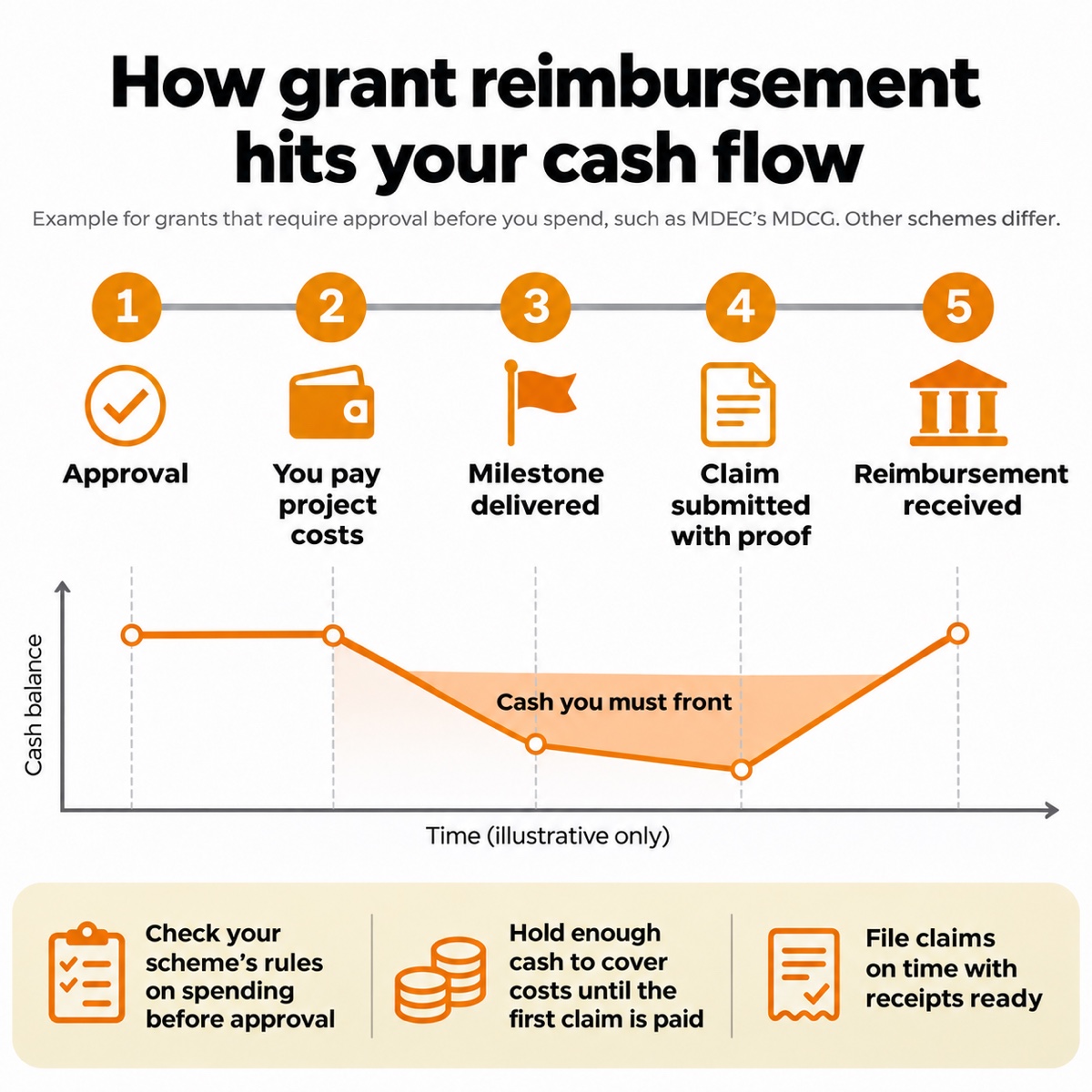
Several programmes pay after you spend. Cradle mixes advances with reimbursements tied to milestones. MDEC reimburses approved costs after each deliverable, with claims verified by an external auditor. MATRADE reimburses after the activity. LiKES offers an RM2,000 advance, while its matching grant works on a pay-and-claim basis.

Timing rules also differ. MDEC’s MDCG and MDXG pages and MRANTI’s Dana Pengkomersialan page say they do not cover costs incurred before approval. MATRADE’s MDG works the other way round, with the claim submitted within 30 days after the event, listing or certification. Check each programme’s rules on eligible spending dates before you commit money.
So map your runway before you apply. How many months could you carry salaries, suppliers and rent before the first claim lands? This is where fixed costs matter. A conventional office lease asks for deposits and fit-out money before you move in, which is cash you may need to front grant-funded work. Our office calculator compares the upfront cash outflow of a WORQ private office with a conventional office lease, so you can see the gap in your own numbers.
Check Overlap Rules Before You Combine Grants
Rules on holding more than one grant vary by programme, and this guide does not cover every agency’s position. MDEC is explicit for its MDCG and MDXG grants. If you already hold an ongoing grant from another government agency, you must prove that the MDEC project is different and does not overlap, with a letter from that agency or equivalent. Companies with common shareholders can hold only one MDEC grant per project at a time, and past MDEC recipients can reapply only one year after project completion.
For any other programme, read the guidelines and funding agreement for overlap or co-funding restrictions before you apply, and declare the support you already hold. Keeping each funded piece of work as a separate project with its own budget and milestones makes those declarations easier.
Prepare These Five Things Before Any Window Opens
- Eligibility proof: company age, ownership, revenue and, for MDEC, your MD or MSC Malaysia status
- IP position: ownership or an exclusive licence, which both Cradle and MRANTI’s Dana Pengkomersialan require
- A milestone budget: costs mapped to deliverables, following each programme’s spend rules
- Pitch materials: a deck built on the agency’s template where one exists, as Cradle and MDEC both use
- A calendar alert: the MDAG-AI window lasted 11 days and the DCG 2026 window about 11 weeks, so set reminders and check the MYStartup funding directory as part of your routine
Plan Your Runway at WORQ
A grant timeline gives you a few quiet months of building, followed by bursts of pitching, reporting and claims. We set up our spaces so small teams can grow without signing a long lease first, and so you can work alongside other founders instead of building alone.

If Cradle is on your shortlist, our Sunway Putra outlet is in Sunway Putra Mall at 100 Jalan Putra, the same street address Cradle lists for its office in Sunway Putra Tower, and a minute’s walk from PWTC LRT station. You can also browse WORQ coworking locations across the Klang Valley to find a base close to your team. Come and visit, bring your grant plan, and let’s work out what space fits your runway.
Frequently Asked Questions
Can foreign founders apply for startup grants in Malaysia?
Some programmes allow it with conditions. MDEC’s MDCG accepts majority foreign-owned companies at a lower share of up to 30% of project cost, with issued share capital of at least RM500,000, and the now-closed MDXG added a Malaysian headquarters requirement. Cradle’s CIP Spark accepts non-Malaysians living in Malaysia as part of a team that includes at least one Malaysian, and both CIP programmes accept companies under 51% Malaysian ownership if most employees are Malaysian. MTDC’s NTIS Fund and MRANTI’s Dana Pengkomersialan are limited to Malaysian individuals or majority Malaysian-owned entities.
What happens if we miss a grant milestone?
The outcome depends on your programme’s funding agreement, so read its breach and termination clauses before you sign. Cradle makes meeting milestone deliverables a prerequisite for further advance payments and reimbursements, and its CIP grants can require you to pay back the amount disbursed on termination and under other agreement terms. MDEC’s DCG terms list a missed deliverable or a late claim as grounds for termination, and a terminated recipient can face a clawback of the amount disbursed and blacklisting. If a milestone is at risk, raise it with the agency before the deadline passes.
Can a startup grant pay for our office rent?
It depends on the programme, and often the answer is no. MDCG lists office rental as non-claimable. MDXG only allowed workspace rental outside Malaysia. The now-closed MDAG-AI did list rental of business premises used for the project as eligible. Read each programme’s eligible expense list before you count rent in your budget, and plan to cover your local workspace from your own runway unless the guidelines say otherwise.
How often should we check grant status?
Check the official page when you start planning, again before you write, and again before you submit. MDAG-AI’s 2025 window lasted 11 days, which could open and close between two monthly checks. While you are preparing an application, follow the agency’s announcements and check the programme page every week or two.