

Key Takeaways
- Plan backwards from your first working day, not forwards from your notice letter. Fix three dates first (lease end, keys to the new office, first working day) and put one named owner against every task.
- The costly gaps sit between tasks: internet not live, access cards not issued, building move slots not booked and addresses not updated. In Malaysia, a company must notify SSM within 14 days of changing its business address or its registered office address. Sole proprietorships and partnerships registered under the Registration of Businesses Act have 30 days.
- A move does not have to mean a fit-out. A furnished private office with Wi-Fi already in place turns furniture, fit-out and most internet set-up into checks rather than projects, so your team can focus on people, data and paperwork.
An office relocation checklist in Malaysia only works if it tells you who owns each task and when it has to be done, not just what needs doing. A list that only says “book movers” and “update your address” misses the problems that sit between those tasks: the fibre line that takes longer to install than you planned, the building that only allows moves outside office hours, or the SSM update nobody was assigned.
This guide gives you a task-owner timeline that runs from the day you serve notice on your lease to your team’s first working day in the new space. It covers IT continuity, packing and movers, landlord and building arrangements, staff communications, Malaysian address notifications and the access tests that show you are ready.
You will not be the only business on the move. In its Kuala Lumpur and Selangor Office Monitor 2Q2026, reported by The Edge Malaysia, Knight Frank said net absorption in the Kuala Lumpur office market rose to slightly over one million sq ft in the quarter, supported by major corporate relocations and continued take-up in newer Grade A buildings. Knight Frank also expects continued expansion by flexible workspace operators to broaden occupier choice, particularly for businesses with variable headcount or shorter-term needs. So if your lease is ending, a conventional lease is not your only route. Let’s make sure the move itself does not cost you a week of lost work.
Start With 3 Dates, Not 1
A move has three dates, and most planning slips when a team works to only one of them.
- Lease end date. The scheduled end of your tenancy. Your notice clause works backwards from this date. Some obligations, such as reinstatement, final charges and the deposit refund, can run past it, so track those separately.
- Keys date. The first day you can access the new office to install internet, furniture and equipment.
- First working day. The day your team arrives and expects everything to work.
The gap between the keys date and the lease end date is your overlap. Overlap costs money because you pay for two spaces, but it buys you time to test internet, phones and access before staff arrive. A short overlap can cost less than a lost working week.
Write these three dates at the top of your plan. Every deadline in the rest of this checklist hangs off them.
Read your lease before you pick the dates
Pull out your current tenancy agreement and check:
- The notice period and how notice must be served (in writing, to which address, to whom)
- Any renewal option with its own deadline
- The reinstatement clause: what condition you must return the office in
- Deposit refund conditions and timing
- Any outstanding service charges, utility deposits or fit-out obligations
If anything is unclear, get the landlord’s answer in writing before you serve notice. A missed notice date can lock you into another term.
Assign Owners Before You Assign Tasks
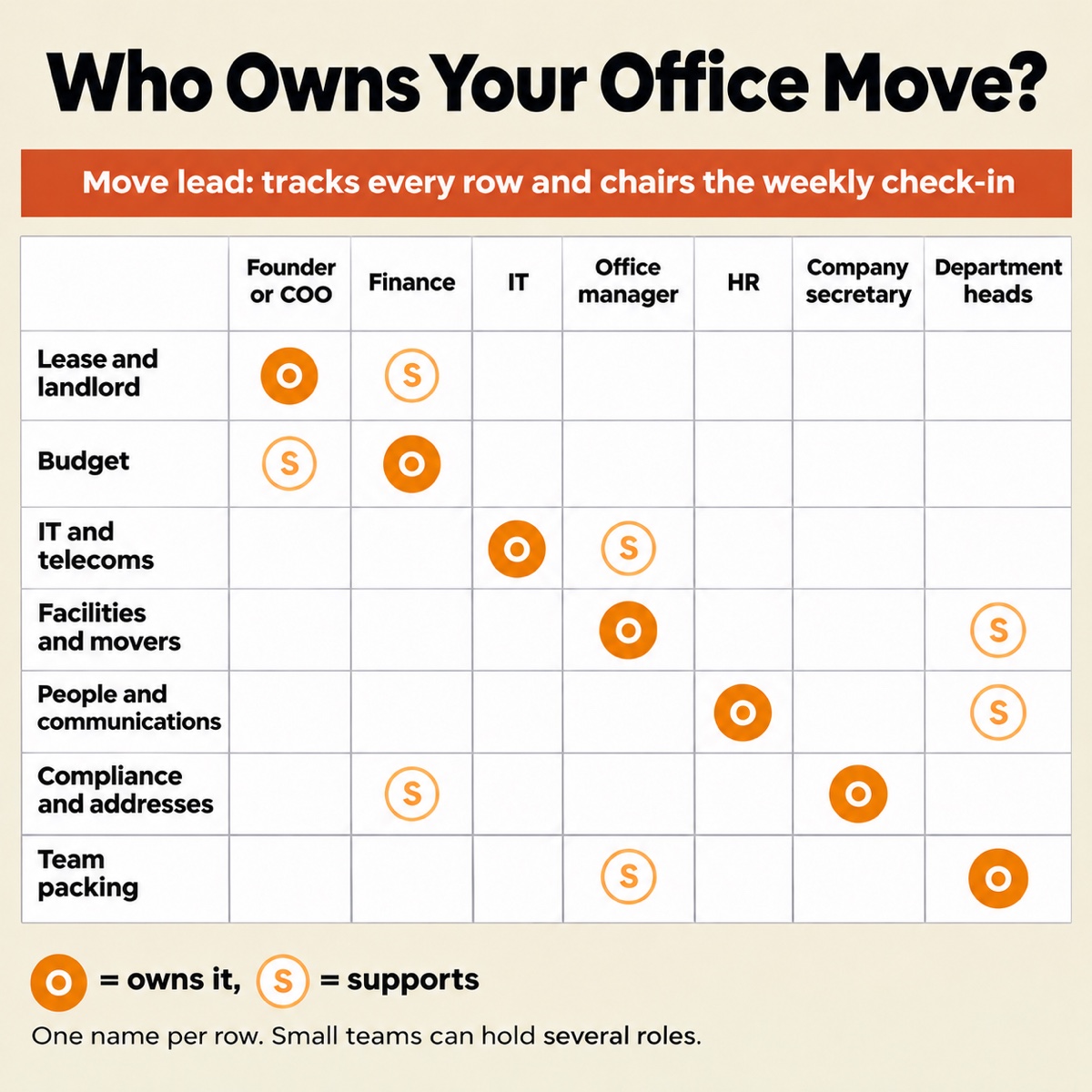
An office move touches finance, people, IT, facilities and compliance at the same time. When everyone owns the move, nobody owns the SSM update.
Name one move lead who holds the plan, tracks every owner’s progress and chairs a short weekly check-in. Then give every workstream a single owner:
| Workstream | Typical owner | Owns |
|---|---|---|
| Lease and landlord | Founder or COO | Notice, new agreement, deposits, reinstatement scope |
| Budget | Finance lead | Overlap costs, movers, fit-out or set-up costs, deposit tracking |
| IT and telecoms | IT lead or IT vendor | Internet, phones, network, data backup, device moves |
| Facilities and movers | Office or admin manager | Mover quotes, packing plan, building permits, access cards |
| People and communications | HR lead | Staff announcements, commute questions, employment terms |
| Compliance and addresses | Company secretary, supported by finance | SSM, LHDN and other address updates, stamping |
| Team packing | Department heads | Packing their area, confirming day-one needs |
In a five-person company, one person may hold three of these roles, and the move lead may also own one of the rows. That is fine. What matters is that each line has a name next to it.
Your Office Relocation Timeline, Worked Backwards
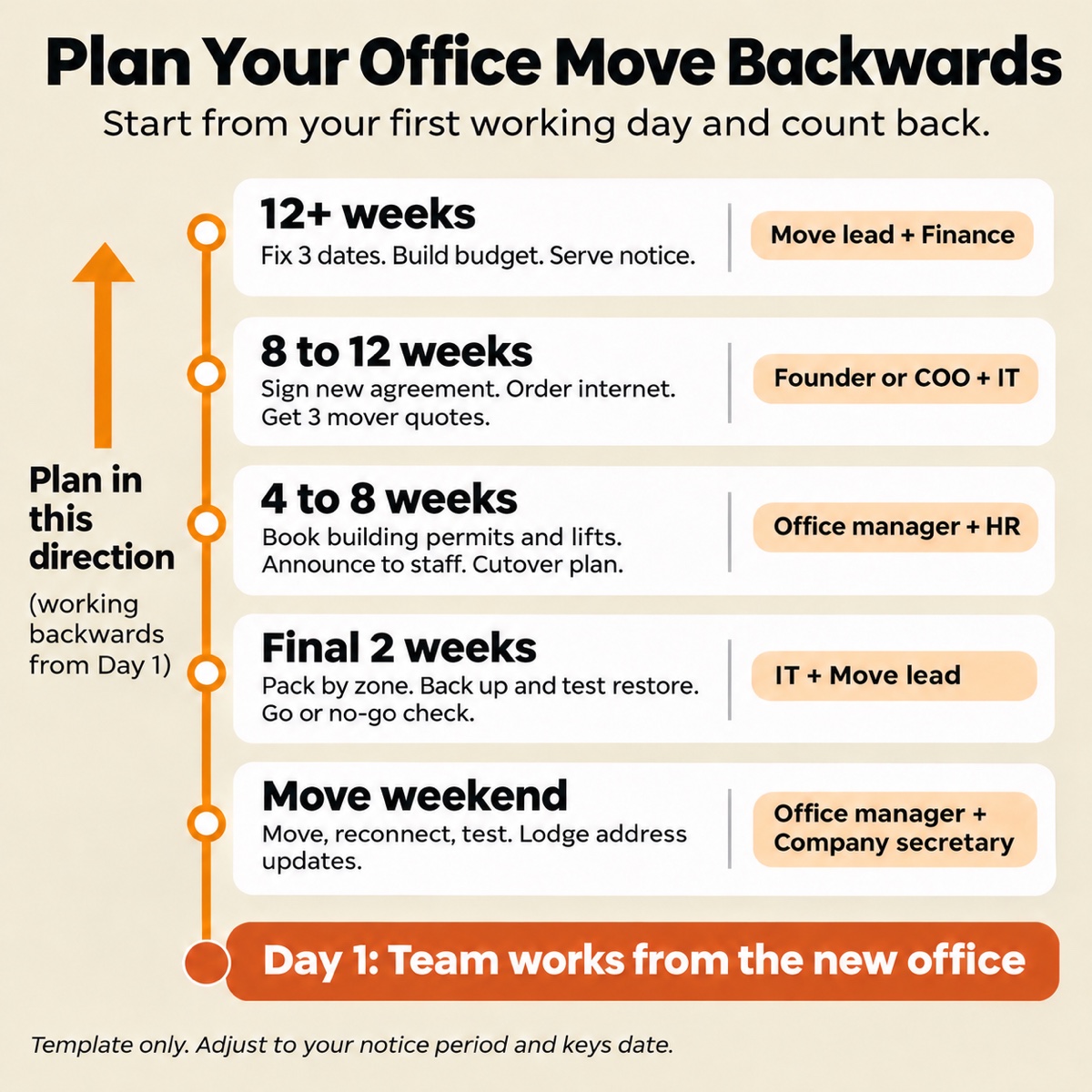
The timeline below is a planning template, not a rule or a legal requirement. A five-person team moving into a furnished office can compress it. A 60-person team building out a bare unit will need more time at the front. Adjust each phase to your notice period and your keys date.
Phase 1: 12 weeks or more before your first working day
- Move lead: Confirm the three dates and the overlap you can afford.
- Finance: Build the move budget. Include overlap rent, mover quotes, reinstatement, new deposits, any fit-out, IT set-up and a contingency line.
- Founder or COO: Shortlist and visit options. If you are comparing a conventional lease with renting a coworking space in Malaysia, put the notice period, deposit, refund terms and monthly inclusions side by side, and get each answer in writing.
- Founder or COO: Serve notice on the old lease in the form the agreement requires. Keep proof of delivery. If your notice period means serving it before the new agreement is signed, get the new space confirmed in writing first and agree a fallback, such as a short extension or a temporary flexible office, in case the new deal falls through.
Phase 2: 8 to 12 weeks before
- Founder or COO: Sign the new agreement. If it is an instrument that needs stamping, such as a tenancy agreement, LHDN requires instruments to be stamped within 30 days of execution in Malaysia, and late stamping carries penalties. Agree with the landlord who arranges the stamping.
- IT: Order internet for the new address now. Ask the provider for the installation lead time in writing and whether the building is already wired for their service.
- Office manager: Get at least three mover quotes based on a site visit, not a phone estimate.
- Office manager: Start an inventory. Tag what moves, what gets sold or donated, and what gets disposed of.
- HR: Draft the staff announcement for release once the new agreement is signed.
Phase 3: 4 to 8 weeks before
- Office manager: Request the building management rules for both buildings. Book move permits, loading bays and service lifts.
- IT: Write the cutover plan (more on this below). Book the installation date for at least a week before staff arrive.
- HR: Announce the move, with the new address and the first working day.
- Company secretary: Confirm which SSM records change, the date each change takes effect and who will lodge them.
- Department heads: Start clearing files and equipment nobody needs.
Phase 4: The final 2 weeks
- Office manager: Deliver packing materials and labels. Share the floor plan with zone codes.
- IT: Run a full backup and test a restore. Confirm internet is live at the new site.
- HR: Send the day-one guide: how to get in, where to sit, where to park, who to call.
- Move lead: Hold a go or no-go check two working days before the move.
Move weekend and the week after
- Office manager: Supervise the movers at both ends. Check off boxes by number.
- IT: Reconnect, test and sign off before the first working day.
- Company secretary: Lodge the address updates within the deadlines in the address section below. The SSM clock runs from the date of the change, not from when you finish unpacking.
- Move lead: Book the joint inspection and handover of the old office.
IT Continuity: Move the Work, Not Just the Hardware
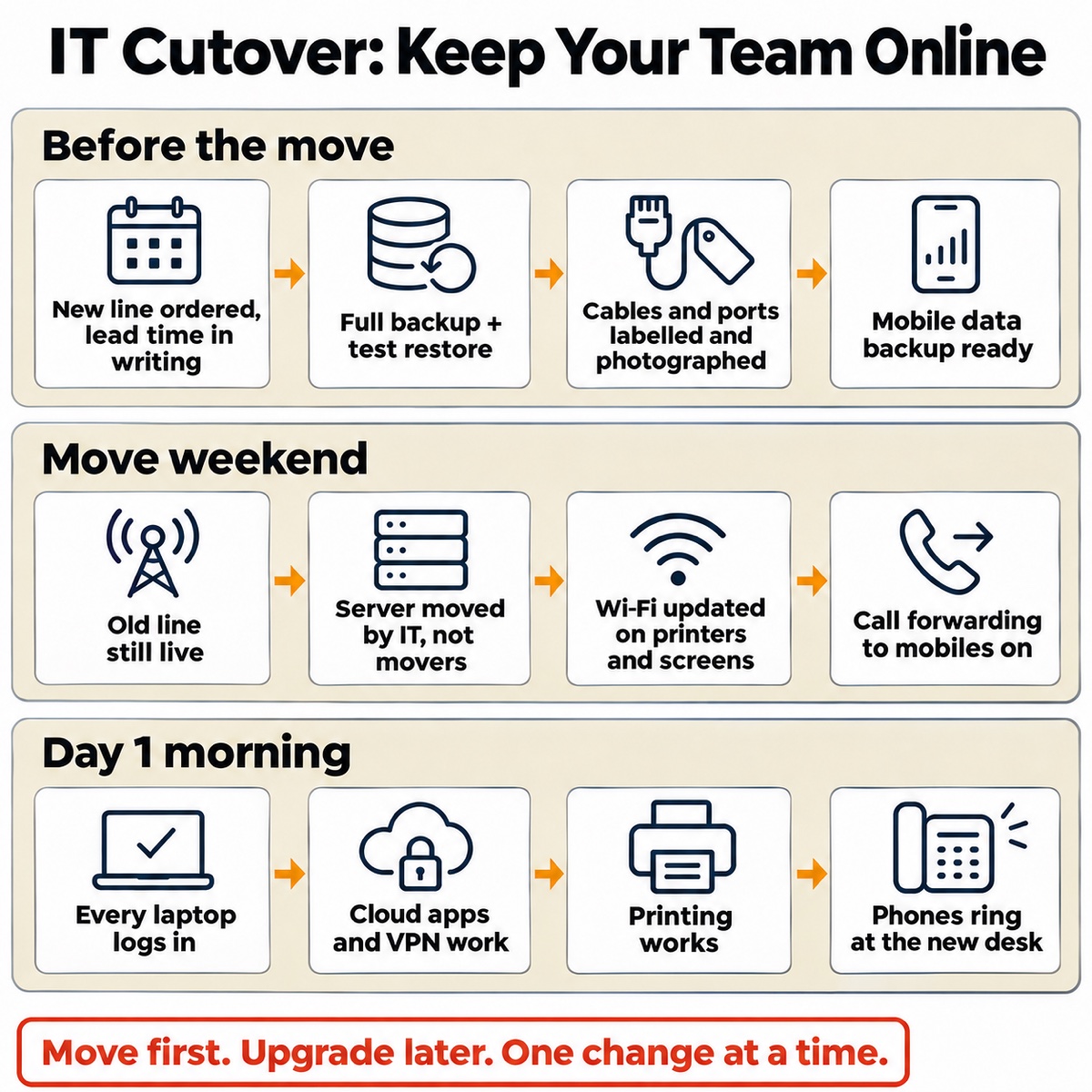
Your team can live without a pantry for a day. They cannot live without internet, logins and phones. Treat IT as its own project with its own owner and its own test.
Do not change everything at the same time
It is tempting to use the move to switch internet provider, replace the phone system and roll out new laptops all in one weekend. When something breaks on the first working day, you will not know which change caused it.
Move first, upgrade later. Keep the same devices, accounts and phone numbers through the move where you can. Make one change at a time once the team is settled.
Internet and network
- Order the new line early and ask for the lead time in writing.
- Keep the old line running until the new one passes a full-day test.
- Arrange a mobile data backup (a 4G or 5G router or hotspot) for the move week.
- Label every cable, switch port and patch panel before you unplug anything. Photograph the set-up.
- Update Wi-Fi details on shared devices such as printers, meeting room screens and door systems.
Phones and numbers
- Ask your provider whether your fixed-line numbers can move with you, and how long the transfer takes.
- Set call forwarding to mobiles for the cutover window.
- Update voicemail greetings and auto-attendant messages with the new address.
Data, devices and security
- Run a full backup and test a restore before the move. If you have never restored a backup, you do not know whether it works.
- If you have an on-site server or storage device, have IT move it personally, not the general movers.
- Clear stored scans and address books from leased printers and copiers before they go back.
- Cancel or reset alarm codes, door PINs and access cards at the old office once you leave.
Packing and Movers: Compare Like for Like
Get quotes you can compare
Mover quotes vary as much in what they include as in price. Ask every mover to quote on the same scope after a site visit:
- Packing materials and who packs (you, them or both)
- Dismantling and reassembling furniture and workstations
- Insurance cover for goods in transit and how claims work
- Handling of IT equipment, safes, server racks or heavy items
- After-hours or weekend surcharges
- Disposal of unwanted furniture and packaging
- Who coordinates with each building’s management
Put the answers in one table before you choose. A low quote can leave out reassembly or after-hours work, which the building may require.
Label by destination, not by origin
Movers do not need to know where a box came from. They need to know where it goes.
- Give each zone in the new office a colour and a letter (for example, orange A for the open area, red B for the meeting room).
- Number every box and log it on a shared sheet.
- Put the zone plan on the wall at the new office entrance on move day.
- Ask each person to pack their own desk and keep one small box of essentials with them.
Shred, do not dump
Moves surface years of paper: old payslips, client files, CVs, ID copies. The Personal Data Protection Act 2010 sets out a security principle and a storage principle that cover how you protect personal data and how long you keep it. A skip outside the office is not a safe disposal method. Check your own retention needs with finance and HR first, then use a shredding service and keep its disposal record.
Landlord and Building Arrangements at Both Ends
You are dealing with two buildings, and each has its own rules. Start these conversations early, because building management may need written requests and supporting documents before it approves a move.
At the old office
- Confirm the reinstatement scope with the landlord in writing. Ask for any required contractor list.
- Book a joint inspection date for the end of your move-out.
- Book loading bay and service lift slots for move-out.
- Give notice on service contracts such as cleaning, pest control, water dispensers, security and plant care. Check each contract’s own notice period.
- Arrange final meter readings and utility account closures.
- Ask building management whether it can hold or forward mail and deliveries for a set period.
At the new office
- Request the house rules for moves: permitted hours, floor and lift protection, contractor registration and any move deposit.
- Book loading bay, service lift and lorry parking.
- Submit the list of staff who need access cards, with enough time for cards to be issued before day one.
- Ask about air-conditioning hours, after-hours access and visitor registration.
- Confirm the lobby directory and floor signage will show your company name.
Moving into a coworking space in KL? Member entry hours and staffed reception hours can differ, and after-hours air-conditioning may follow the building’s timetable. Confirm who can let movers in and receive deliveries outside office hours before you book the lorry.
Staff Communications That Answer the Real Questions
Staff questions about a move tend to be personal: their commute, their parking and whether their things will arrive. Answer those questions before anyone has to ask.
A simple message schedule
| When | Message | Owner |
|---|---|---|
| Once the new agreement is signed | The move is happening: new address, first working day, why we are moving | Founder or HR |
| 4 to 6 weeks before | Commute options, train lines, parking, accessibility questions | HR |
| 2 weeks before | Packing instructions, zone plan, what to take home | Office manager |
| 1 week before | Day-one guide: how to get in, access cards, seating, Wi-Fi, who to call | HR and IT |
| Day 1 | Welcome note and a short “report a problem” form | Move lead |
| End of week 1 | Quick feedback survey and a fix list | Move lead |
A few practical points:
- If the move changes where people are contracted to work, talk to HR or your legal adviser before you announce it.
- Invite people with mobility, health or caregiving needs to raise them privately.
- If the move weekend runs into a working day, set it as a work-from-home day and say so early.
Address Notifications in Malaysia: SSM’s 14-Day and 30-Day Rules
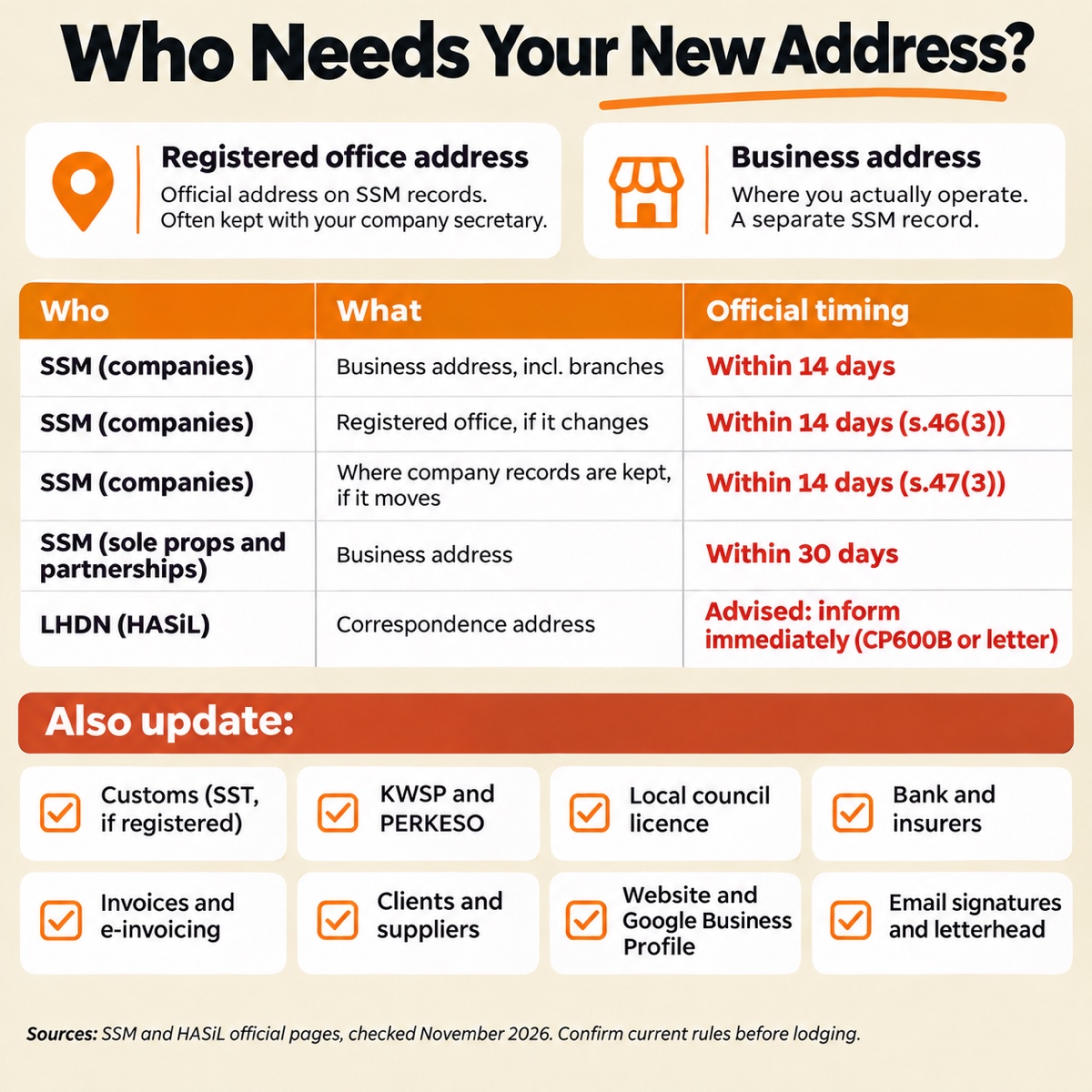
This is the part of an office move that is easy to forget and slow to fix. Start by separating two addresses that many SMEs mix up.
- Registered office address. The official address on your company’s SSM records, where notices to the company can be sent. If yours sits with your company secretary, moving your team may not change it.
- Business address. Where your company actually operates. SSM treats this as a separate record.
Moving your team and changing your registered office are separate questions. A physical move can trigger the business-address notification below even when your registered office stays where it is, so do not skip it. Before you put any new address on SSM records, confirm with your company secretary that the address is acceptable for that purpose. If you are moving into a WORQ office, note that a WORQ address is for mail and correspondence only and cannot be used for SSM company registration.
| Who to notify | What changes | Official timing | Source |
|---|---|---|---|
| SSM (companies) | Business address, including branches | Within 14 days of the change, lodged through SSM’s Corporate Registry System | SSM Practice Directive 2/2017, revised 5 August 2026 |
| SSM (companies) | Registered office address, if it changes | Within 14 days of the change, under section 46(3) of the Companies Act 2016. Usually lodged by your company secretary | Companies Act 2016, sections 46 and 47 (SSM copy) |
| SSM (companies) | The place where you keep company records, if it is the office you are leaving | Within 14 days of the change, under section 47(3) of the Companies Act 2016 | Same as above |
| SSM (sole proprietorships and partnerships) | Business address | Within 30 days of the change, via EzBiz Online or Form B | SSM: Making changes to a registered business |
| LHDN (HASiL) | Company correspondence address and other company details | HASiL advises companies to inform it immediately, using form CP600B or an official letter to the HASiL office that handles the tax file | HASiL: updating company information |
Then work through the rest of your list. We have not set deadlines for these because each body has its own current process, so check with each one or with your payroll and tax advisers:
- Royal Malaysian Customs Department, if you are registered for sales or service tax
- KWSP, PERKESO and any other employer accounts
- Your local council, if you hold a business or signboard licence for the old premises
- Banks, insurers and your insurance broker (your office contents policy may be tied to a specific address)
- Your e-invoicing, accounting and billing systems, invoice templates and quotation templates
- Clients, suppliers, couriers and any regular delivery accounts
- Your website, Google Business Profile, email signatures, letterhead and social media pages
Give the compliance owner a dated tracker with one row per body and a “lodged on” column. That is the evidence you will want if anyone asks later.
Handover and First-Day Access Tests
Close out the old office properly
- Walk the space with the landlord or building manager on the agreed inspection date.
- Take dated photos and video of every room, ceiling, floor and wall.
- Record final meter readings.
- Return every key and access card and get a signed receipt.
- Sign a handover form that lists any agreed outstanding works.
- Diarise the deposit refund date from your lease and follow up in writing if it passes.
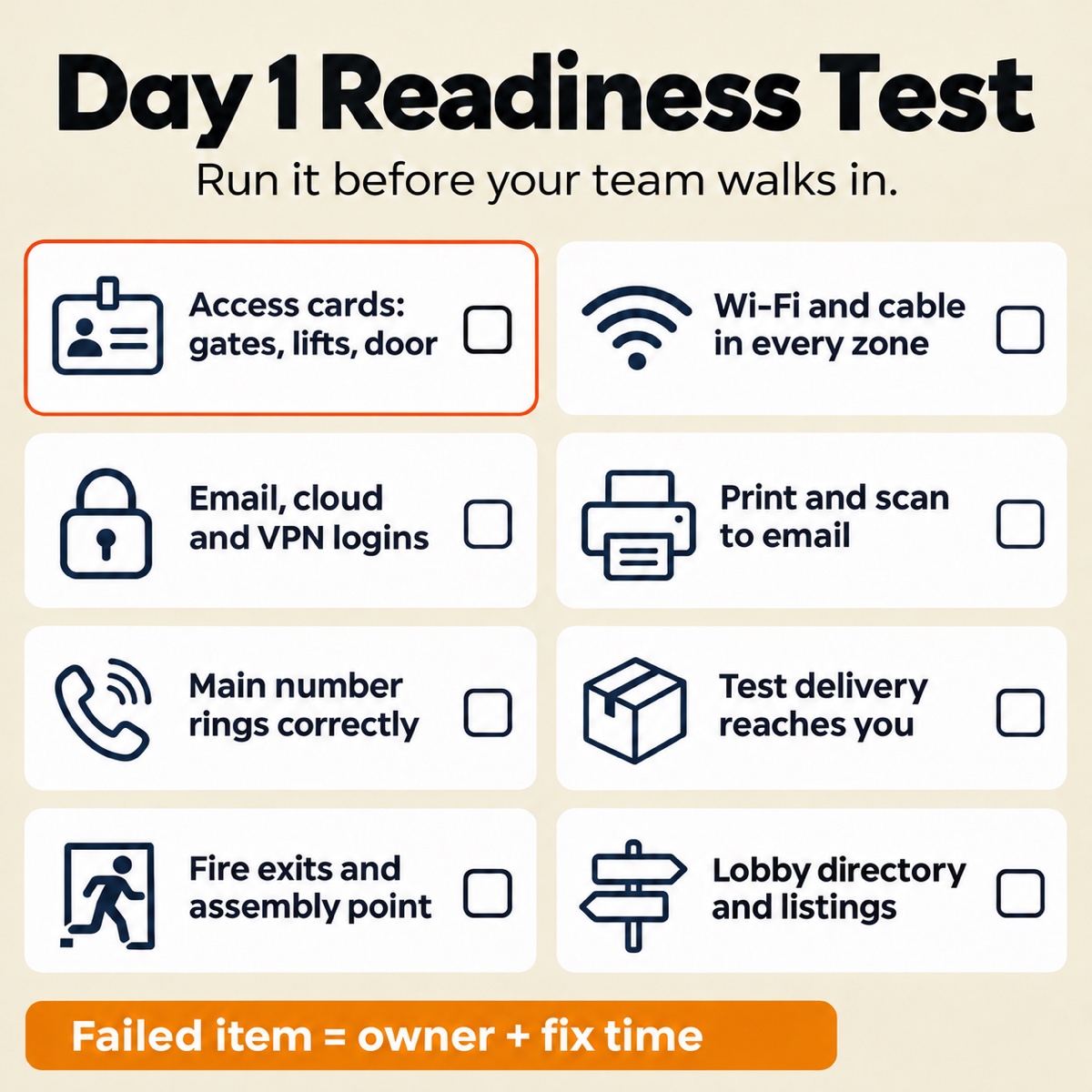
Run a day-one test before your team arrives
Do this the working day before, or early on the first morning. Use real staff cards and real laptops, not the IT lead’s admin account.
- Access: Test a sample of staff cards on the lobby gates, lifts and office door. Confirm every card has been issued.
- Network: Connect over Wi-Fi and cable in different parts of the office. Run a video call from a meeting room.
- Logins: Log in to email, cloud storage, VPN and your main business systems.
- Print and scan: Print, scan to email and scan to folder.
- Phones: Call the main number from outside and check it rings where it should.
- Deliveries: Send a test courier or delivery to the new address and confirm reception or building management knows where it goes.
- Safety: Walk the fire exits and assembly point so you can brief the team on day one.
- Visibility: Check the lobby directory, floor signage and your online listings show the new address.
Anything that fails goes on a fix list with an owner and a time. That list, not the moving boxes, tells you whether you are done.
Shorten the Move With a Ready-to-Use Office
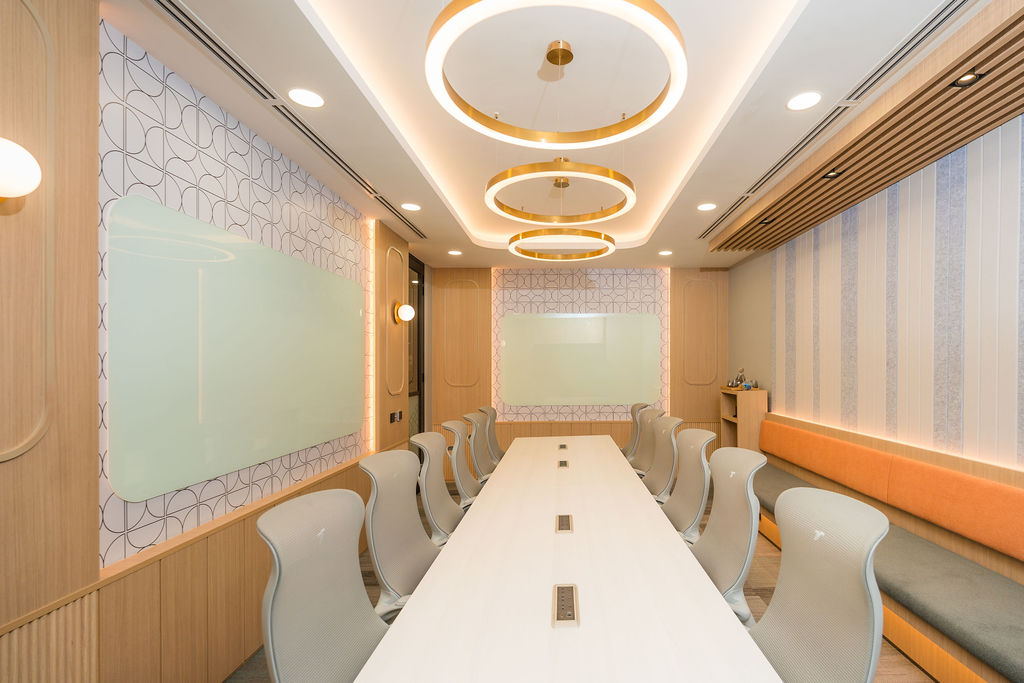
Look back at the timeline. Fit-out, furniture and internet installation are the stages with the longest lead times, and each one depends on a contractor or provider you do not control. If your next office already has all three in place, those stages shrink to checks rather than projects.
That is the case for a furnished private office, one of the membership types you will find in a coworking space in Kuala Lumpur alongside dedicated desks and hot desks. Your team gets its own room without taking on a bare unit.
A WORQ private office comes fully furnished and lockable, with business-grade Wi-Fi, 24/7 member access, mail handling, printers and scanners, phone booths, a stocked pantry and credit-based meeting rooms. Your checklist still includes people, data, the old-office handover and the address updates above, but you are no longer managing a fit-out contractor or waiting on a furniture delivery.
One limit to plan around: a WORQ address is for mail and correspondence only. No WORQ plan, including our private offices and Virtual Office, supports SSM company registration. Moving your team to WORQ does not remove any statutory notification, so ask your company secretary which SSM and LHDN updates the move triggers and where your registered office should sit.
Before you commit to any option, compare the cash you need on day one. Our office calculator sets the initial start-up cash outflow of a WORQ private office against a conventional lease, including deposits, fit-out and furniture, so you can see the difference for your team size, location and contract length.
Planning a move in the Klang Valley? Visit one of our coworking locations, from KL Sentral and Bangsar South to Bandar Utama and Mutiara Damansara in Petaling Jaya, and book a viewing. Bring your three dates and this checklist with you, and we will talk through what a move would involve for your team.

Frequently Asked Questions
Can we move in stages instead of all in one weekend?
Yes, and for larger teams it can lower the risk. One approach is to move one department or one floor first, run it for a week, fix what breaks and then move the rest. You will pay for a longer overlap and need both sites connected to your systems, so weigh that against the cost of a single weekend going wrong.
Who pays for reinstatement when we leave the old office?
Your lease decides. If it has a reinstatement clause, that clause sets what you must restore and who pays, and the scope differs from lease to lease. If the clause is vague, agree the scope and cost split in writing before any work starts, and keep dated photos of the original condition if you have them.
Is a move a good time to switch to hybrid work or downsize?
It can be, because you are already resetting desks, seating and storage. Check actual attendance over a normal month before you cut headcount capacity, and plan for your busiest day, not your average one. Flexible workspace agreements are often easier to resize than a conventional lease, but check the notice and change terms in your agreement first.
What if mail and parcels keep arriving at the old address?
Expect some to arrive for weeks after the move, no matter how early you update your records. Agree a fixed weekly collection day with the old building’s management for a set period, and log every item that still arrives there. Each entry tells you which bank, agency, supplier or courier still has the old address, so you can fix it at the source.






 Enjoy exclusive wellness benefits with Atlas Chiropractic & Physiotherapy, supporting desk-bound professionals with evidence-based chiropractic and physiotherapy care.