
Key Takeaways
- Corporate HR departments save 20-30% on real estate costs by switching from traditional office leases to flexible workspace models
- KL Sentral’s eight transit lines reduce employee commute times and expand your talent pool across the Klang Valley
- Monthly rolling contracts let you scale workspace capacity as your workforce changes without lease break penalties
- Flexible office solutions support hybrid work policies while maintaining team cohesion and company culture
- Malaysia Digital Hub status at KL Sentral locations simplifies compliance for multinational corporations
- HR teams eliminate facility management overhead and redirect resources toward strategic people initiatives
Securing flexible office solutions KL Sentral has become a strategic priority for corporate HR departments managing distributed teams, rapid growth, or workforce restructuring. Traditional office leases create fixed costs that don’t flex with business cycles, while flexible workspace delivers the scalability your workforce actually needs. Your HR team faces pressure to control costs while maintaining productivity, culture, and employee satisfaction. We’ve worked with HR departments from 5-person startups to 500-person enterprises, and the workspace decisions you make today will shape your ability to attract talent and manage headcount changes for years.
Table of Contents
- Why Corporate HR Teams Choose Flexible Workspace Over Traditional Leases
- Calculate Real Estate Costs: Traditional Office vs. Flexible Solutions
- Support Hybrid Work Models Without Sacrificing Team Culture
- Scale Workspace Capacity as Headcount Changes
- Simplify Facility Management and Administrative Overhead
- Navigate Vendor Selection and Contract Negotiation
- Implement Flexible Office Solutions Across Your Organization
Why Corporate HR Teams Choose Flexible Workspace Over Traditional Leases
Your CFO wants predictable costs. Your department heads want team space. Your employees want commute flexibility. Traditional office leases force you to pick two out of three.
Flexible office solutions in KL Sentral solve this by decoupling workspace from long-term financial commitments. You pay for what you use each month and adjust capacity based on actual headcount rather than projected growth from 18 months ago.
CBRE research found that 64% of Asia-Pacific tenants now prefer offices with short-term lease options and shared amenities. That preference reflects the reality that workforce planning has become harder, not easier, in the past five years.
Your HR department benefits in three specific ways:
Budget flexibility. Monthly contracts mean you’re not locked into five-year commitments that become albatrosses when business conditions change. Downsize without lease break penalties. Expand without relocating your entire team.
Reduced capital expenditure. Traditional office fit-outs can cost RM150-300 per square foot before your first employee sits down. Flexible workspace eliminates that upfront investment. Your budget goes toward hiring instead of furniture.
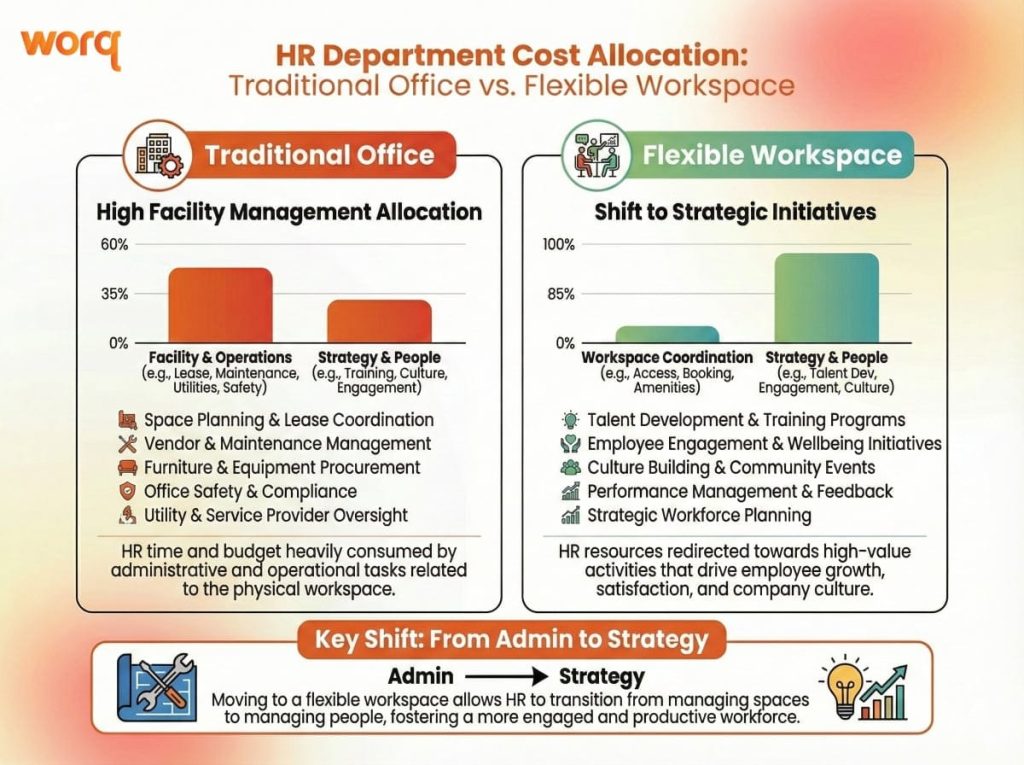
Administrative simplification. Your HR team stops managing facility vendors for internet, cleaning, security, and maintenance. We handle operational details so you can focus on people strategy.
Knight Frank data shows that 78% of tenants prioritize flexibility in leases and shorter setup times. That’s not a trend. That’s the new baseline for corporate real estate decisions.
Calculate Real Estate Costs: Traditional Office vs. Flexible Solutions
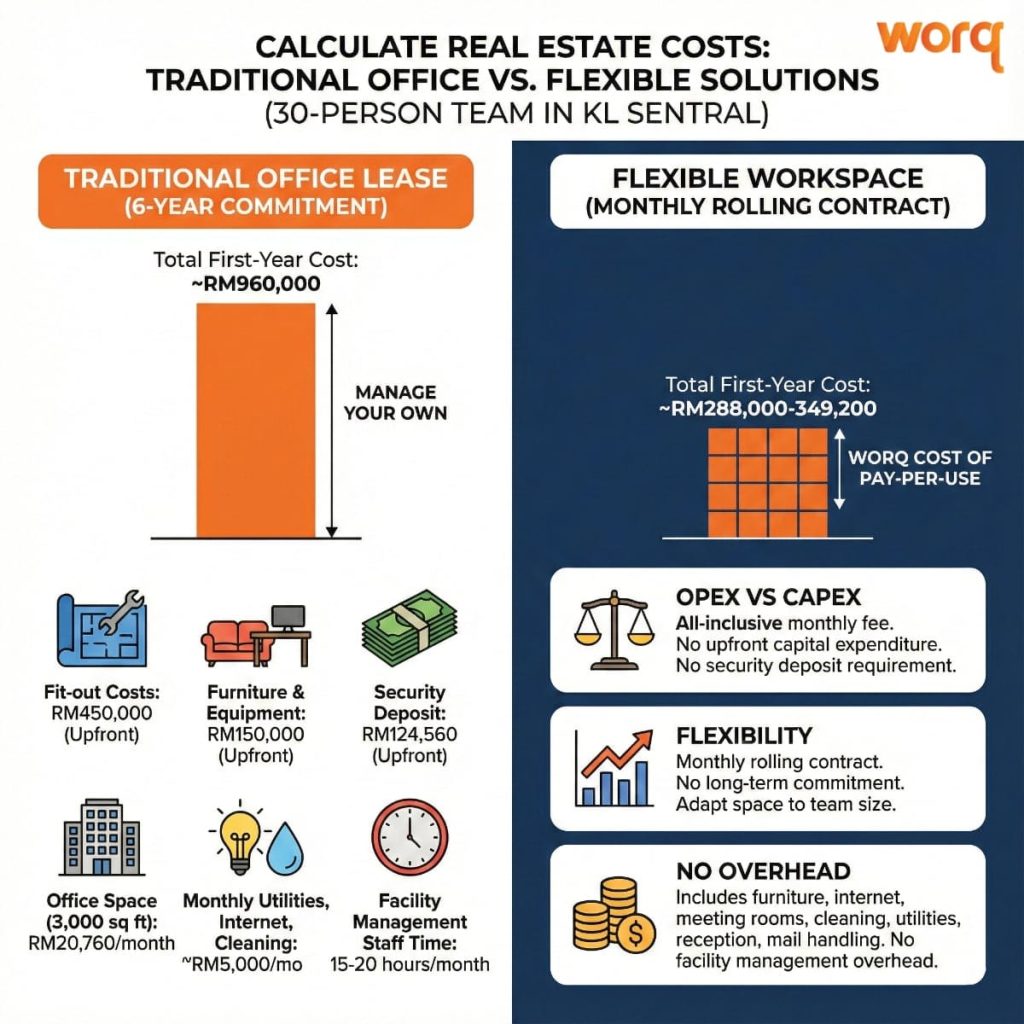
Let’s run the numbers on a 30-person team needing workspace in KL Sentral.
Traditional Office Lease (6-year commitment):
- Office space: 3,000 sq ft at RM6.92/sq ft/month = RM20,760/month
- Fit-out costs: RM150/sq ft × 3,000 = RM450,000 upfront
- Furniture and equipment: RM5,000 per person × 30 = RM150,000 upfront
- Monthly utilities, internet, cleaning: ~RM5,000/month
- Facility management staff time: 15-20 hours/month at loaded cost
- Security deposit: 6 months rent = RM124,560
Total first-year cost: ~RM960,000 (including upfront capital)
Flexible Workspace (monthly rolling contract):
- Private offices at RM800-970/person/month × 30 people = RM24,000-29,100/month
- All-inclusive: furniture, internet, meeting rooms, cleaning, utilities, reception, mail handling
- No upfront capital expenditure
- No security deposit requirement
- No facility management overhead
Total first-year cost: ~RM288,000-349,200
The difference funds three additional headcount or covers your entire annual training budget. These calculations don’t include the hidden costs of managing a traditional lease: HR time spent coordinating vendors, dealing with building management, handling office supply orders, and managing access control. That’s 10-15 hours per month that your HR team could spend on talent development instead.
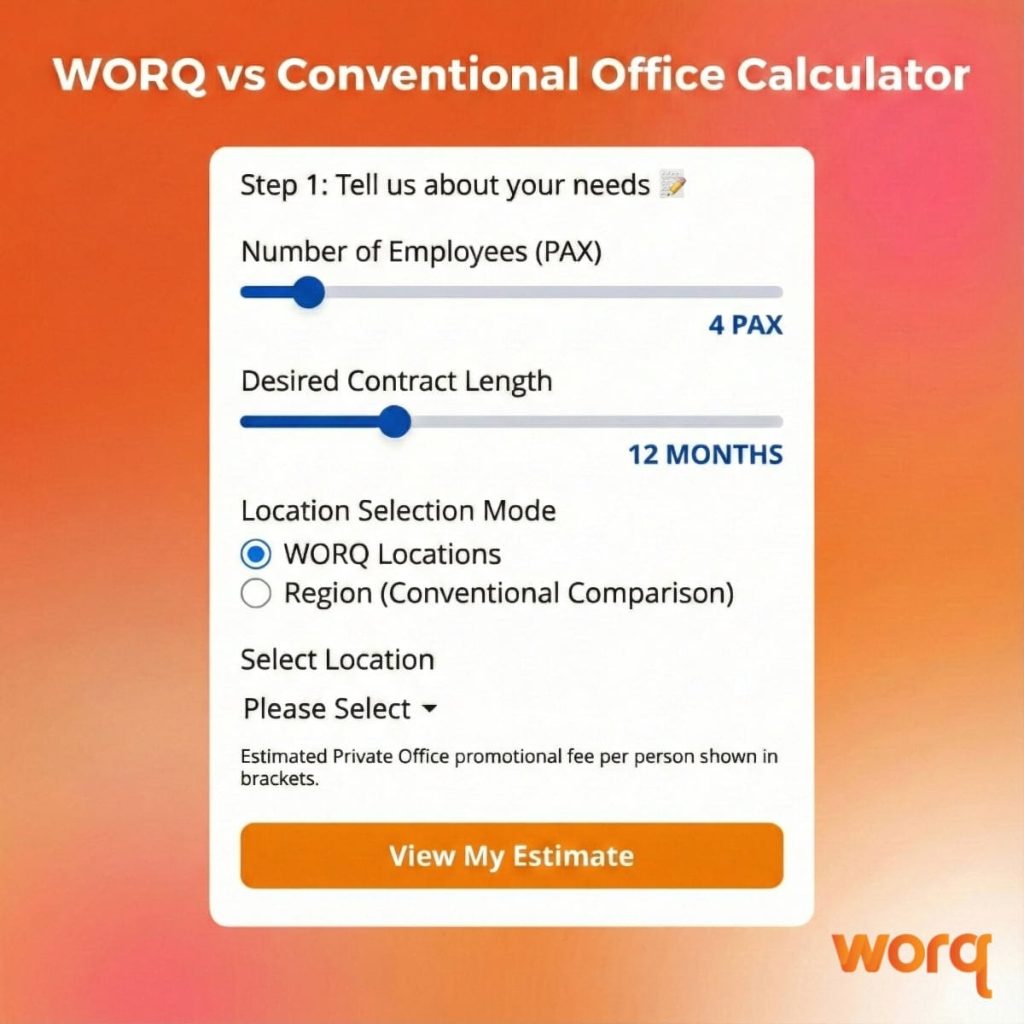
For more accurate calculations tailored to your needs, use our custom-designed office calculator tool below.
Support Hybrid Work Models Without Sacrificing Team Culture
Your hybrid work policy says “3 days in office, 2 days remote.” But on any given day, only 60-70% of your team actually shows up. You’re paying for 30 desks that sit empty 30-40% of the time.
Flexible workspace solves this with two models:
Fixed + Flex Desk Combination. Reserve private offices for your core team or department leads who need consistent space. Add flex desk capacity that any team member can use when they come in. You pay for 20 fixed desks plus flex credits for 15 additional seats rather than committing to 35 permanent desks.
Hub and Spoke Model. Your main team works from our Menara Shell location, while smaller groups or remote employees use hot desks across our KL Sentral, Bangsar, or Subang locations. Your All Access membership lets employees work from whichever location suits their schedule.
This flexibility matters for talent acquisition. Your job postings can genuinely offer hybrid work without the asterisk that says “but you need to be at our Cyberjaya office three days a week.” KL Sentral’s eight transit lines mean candidates from Subang Jaya, Petaling Jaya, Damansara, and Cheras can all reach your workspace in 25-35 minutes by train.
JLL’s Q1 2025 report notes that flexible space providers are revolutionizing workspace specifically because they accommodate hybrid work patterns that traditional landlords can’t support. That revolution started because HR departments demanded better solutions.
Your team culture doesn’t suffer when people have consistent space to collaborate. The challenge with hybrid work isn’t the policy. It’s having the physical infrastructure to support it. Meeting rooms that actually get used. Quiet spaces for focused work. Social areas for unplanned conversations. Flexible workspace is designed for how hybrid teams actually work.
Scale Workspace Capacity as Headcount Changes
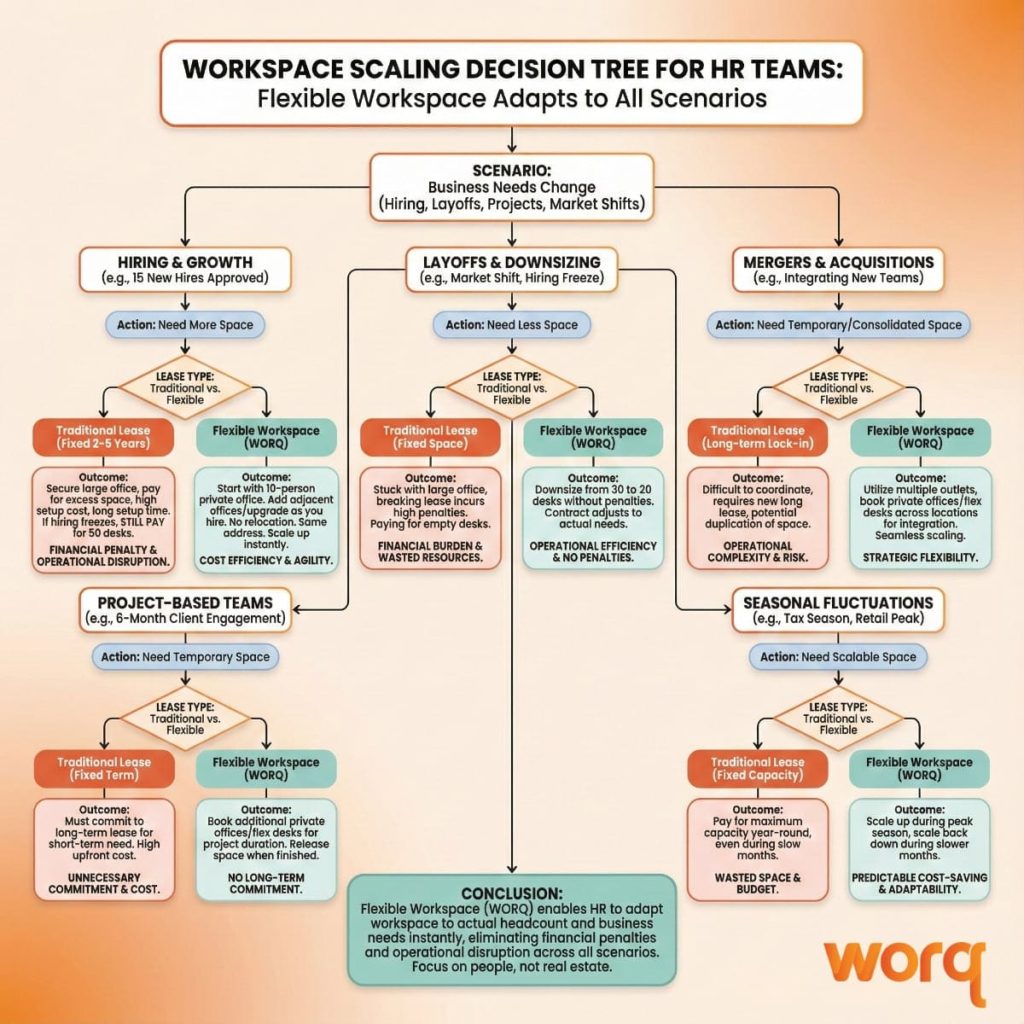
Your finance department approved budget for 15 new hires this quarter. Three months later, the market shifted and hiring froze. Your traditional lease still charges you for 50 desks whether you fill them or not.
Flexible office solutions let your workspace track your actual headcount:
Growth scenarios. Start with a 10-person private office. Add adjacent offices or upgrade to larger space as you hire. No relocation. No lease renegotiation. Your team stays in the same building with the same address.
Reduction scenarios. Market conditions force layoffs or project teams disband. Downsize from 30 desks to 20 without breaking a lease or paying penalties. Your contract adjusts to your actual needs.
Project-based teams. You need space for a 6-month client engagement team. Book additional private offices or flex desks for the project duration. Release the space when the project ends. No long-term commitment for temporary needs.
Seasonal fluctuations. Retail companies, accounting firms, and tax consultancies face predictable seasonal staffing changes. Your workspace scales up during peak season and back down during slower months.
The strategic advantage goes beyond cost control. When your workspace can flex with business conditions, you gain hiring agility. Your recruiter can extend offers faster because workspace isn’t a bottleneck. Traditional office planning requires 3-6 months lead time for expansion. Flexible workspace adds capacity in days.
The Instant Group reports that Kuala Lumpur saw 78% year-over-year growth in flexible workspace demand in 2024, ranking 5th hottest market in Asia-Pacific. That growth came primarily from corporate occupiers, not startups. HR departments discovered that workspace flexibility directly enables business flexibility.
Simplify Facility Management and Administrative Overhead
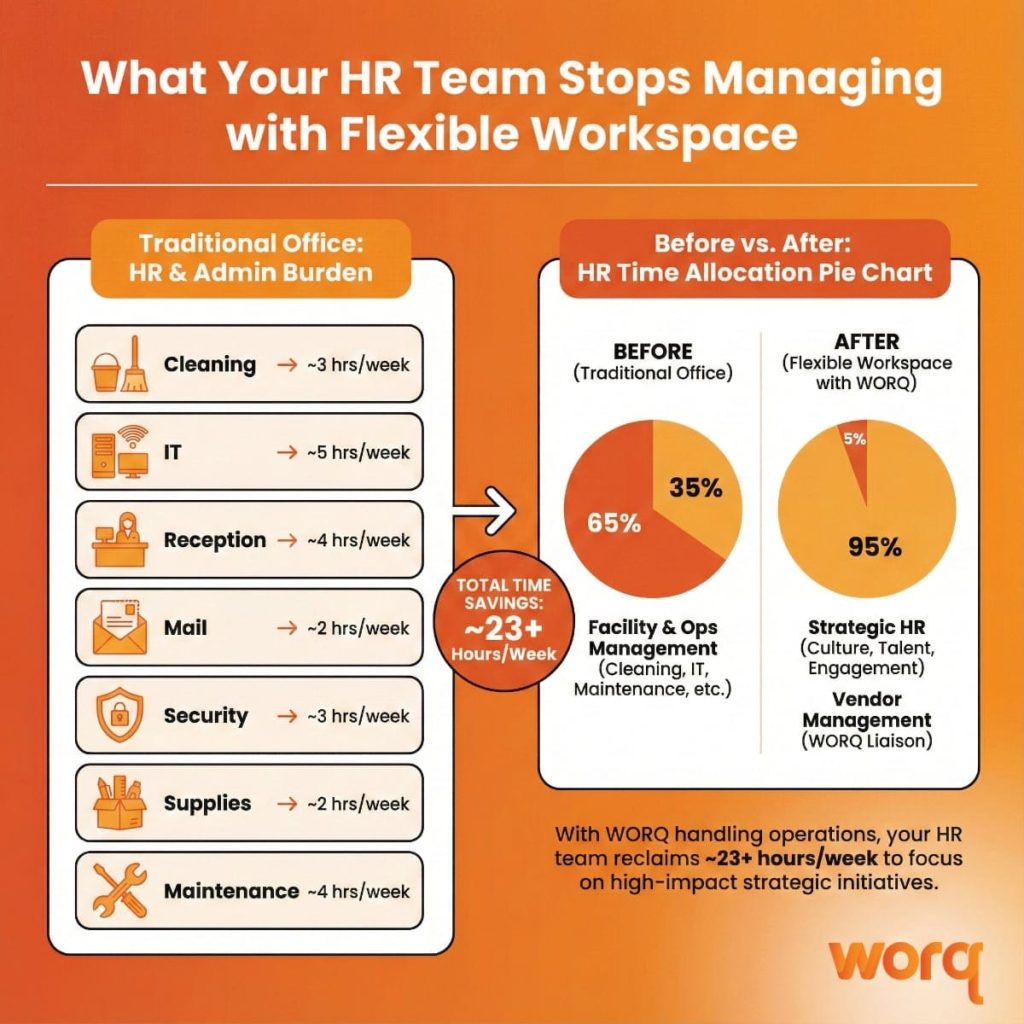
Calculate how much time your HR coordinator spends managing office operations each month:
- Coordinating cleaning service: 2-3 hours
- Handling internet or phone issues: 1-2 hours
- Managing office supply orders: 2 hours
- Scheduling meeting room maintenance: 1 hour
- Processing visitor access: 3-4 hours
- Coordinating building management requests: 2 hours
- Handling mail and package delivery: 2 hours
That’s 13-16 hours per month or roughly 10% of a full-time employee dedicated to facility operations instead of HR functions.
Flexible workspace eliminates this overhead. Our on-site teams handle:
- Daily cleaning and restocking
- IT support and internet connectivity
- Reception and visitor management
- Mail handling and package acceptance
- Meeting room setup and AV equipment
- Security and access control
- Coffee, snacks, and pantry supplies
- Maintenance and repairs
Your HR team’s involvement drops to zero. Your coordinator focuses on onboarding, employee relations, and benefits administration instead of chasing down the cleaner or troubleshooting the printer.
Beyond facilities management, flexible workspace directly supports your HR retention and development initiatives. WORQ’s regular community engagement events and makan-makan sessions create informal networking opportunities that build team cohesion and workplace satisfaction. These aren’t forced team-building exercises, they’re organic opportunities for your employees to connect with peers across companies and industries.
Our learning and development (L&D) programme upskills your team in AI, digitalisation, and business technology without additional training budget. Monthly workshops and skill-sharing sessions give your employees professional development opportunities that contribute directly to retention. When employees see their employer providing workspace that invests in their growth, it signals that you’re committed to their career progression.
The cost savings extend beyond labor hours. Traditional office management requires vendor relationships, contract negotiations, and payment processing for a dozen different services. Flexible workspace consolidates everything into a single monthly invoice. Your accounts payable team processes one payment instead of ten.
Navigate Vendor Selection and Contract Negotiation
Your CFO approved flexible workspace in principle. Now you need to select a vendor and negotiate terms. Here’s what matters:
Location and Transit Access. KL Sentral connects eight transit lines. Your location decision determines who can realistically work for you. When evaluating KL Sentral office locations, transit connectivity should be your first filter, not your third.
Membership Flexibility. Can you scale up and down easily? What’s the notice period for changes? Are there penalties for downsizing? Get specifics in writing before you commit.
Building Certifications. LEED and GBI certifications matter for multinational corporations with sustainability mandates. Malaysia Digital Hub and MSC Status matter for compliance and government program participation. Both our KL Sentral locations carry these certifications.
Amenity Quality. Not all coworking spaces are equal. Visit during business hours. Test the internet speed. Try the meeting rooms. Talk to existing members about their experience. Your decision impacts your entire team for months or years.
Financial Stability. The flexible workspace market consolidated after WeWork’s bankruptcy. Check how long the operator has been in business and whether they own or lease their locations. Companies operating since 2017 survived COVID-19 and the coworking shakeout.
Contract Terms. Read the fine print on:
- Included services vs. additional charges
- Meeting room hour allocation
- Notice periods for termination or changes
- Price escalation clauses
- What happens if you need to break the contract
Total Cost of Occupancy. Compare all-in costs, not just the per-desk rate. Traditional office rent might look cheaper until you add utilities, internet, furniture, cleaning, and facility management time.
Your procurement department will want to negotiate. Flexible workspace operators often offer discounts for longer commitments or larger teams. Ask about:
- Multi-location access for distributed teams
- Volume discounts for teams over 20 people
- Quarterly or annual payment discounts
- Free trial periods or day passes before commitment
Implement Flexible Office Solutions Across Your Organization
You’ve selected a vendor and signed the contract. Now you need to onboard your team and make the transition smooth.
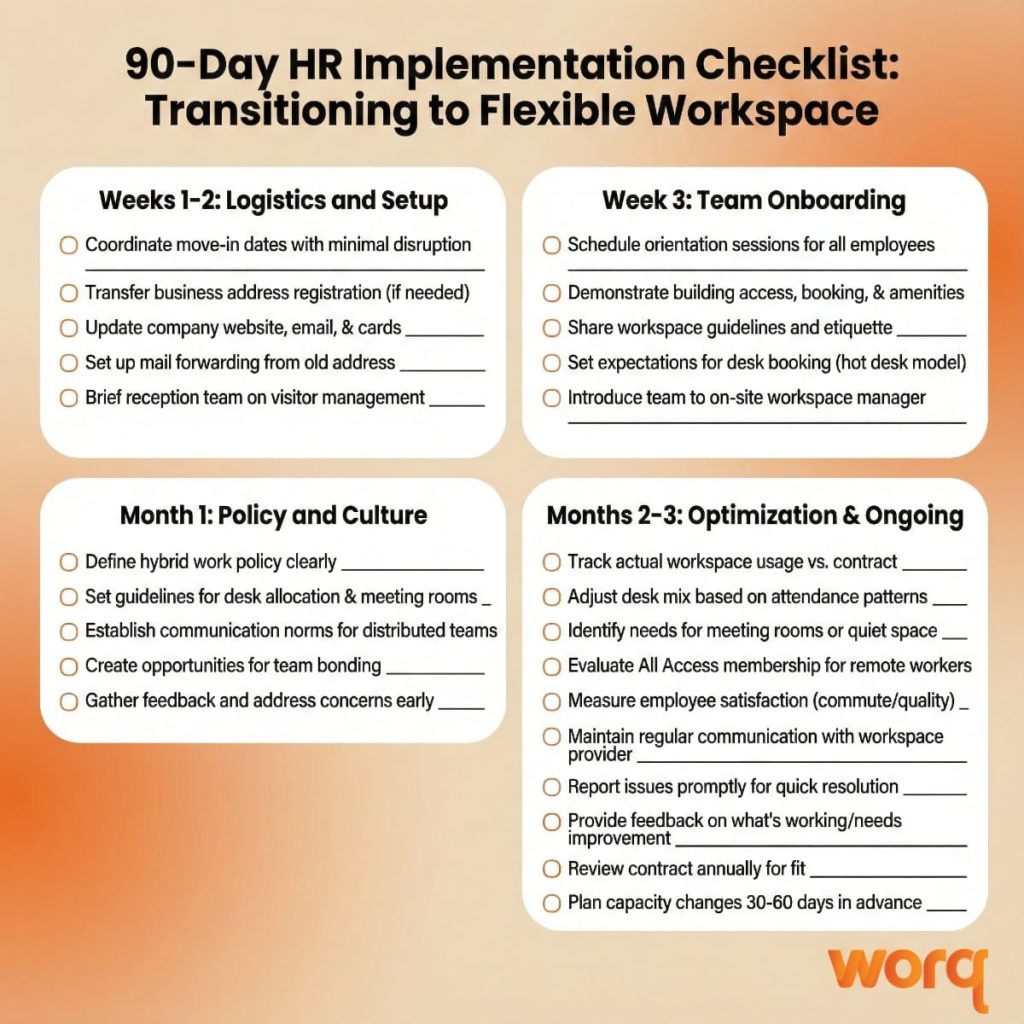
Weeks 1-2: Logistics and Setup
- Coordinate move-in dates with minimal disruption
- Transfer business address registration (if needed)
- Update company website, email, & cards with the new flexible workspace address.
- Set up mail forwarding from old address for a minimum of 3-6 months.
- Brief reception team on visitor management and new guest registration protocols.
Week 3: Team Onboarding
- Schedule orientation sessions for all employees
- Demonstrate building access, booking, & amenities
- Share workspace guidelines and etiquette document via email and the company intranet.
- Set expectations for desk booking (hot desk model)
- Introduce team to on-site workspace manager
Month 1: Policy and Culture
- Define hybrid work policy clearly including in-office vs. remote day expectations.
- Set guidelines for desk allocation & meeting rooms booking procedures and usage etiquette.
- Establish communication norms for distributed teams
- Create opportunities for team bonding in the new communal areas and breakout spaces.
- Gather feedback and address concerns early through pulse surveys and open forums.
Months 2-3: Optimization & Ongoing
- Track actual workspace usage vs. contract capacity to identify underutilized areas.
- Adjust desk mix based on attendance patterns (e.g., increase hot desks, decrease dedicated seats).
- Identify needs for meeting rooms or quiet space and reconfigure zones based on utilization data.
- Evaluate All Access membership for remote workers
- Measure employee satisfaction (commute/quality) with a follow-up survey and focus groups.
- Maintain regular communication with workspace provider through scheduled monthly or quarterly check-ins.
- Report issues promptly for quick resolution via the provider’s dedicated support channel or app.
- Provide feedback on what’s working/needs improvement during periodic performance reviews with the provider.
- Review contract annually for fit with evolving business needs and headcount projections.
- Plan capacity changes 30-60 days in advance to ensure seamless scaling and space availability.
Why WORQ Delivers the Flexible Office Solutions Your HR Team Needs
We’ve operated in KL Sentral since 2017, building workspace specifically for how corporate teams work in Malaysia. Our two locations give your HR department options based on team size and budget.
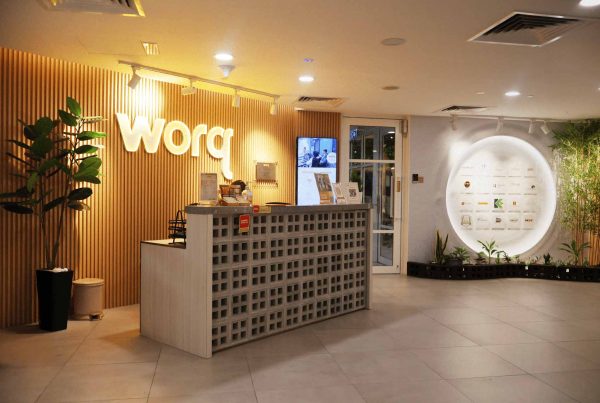
WORQ Menara 1 Sentrum sits 2 minutes from KL Sentral station. You get the full range from hot desks to private offices, plus virtual office packages for distributed teams. The location holds Malaysia Digital Hub and MSC Status certifications that simplify compliance for multinationals.
WORQ Menara Shell focuses on private offices and dedicated desks 7 minutes from the station. The building holds LEED Platinum and GBI Gold certifications. Specialized amenities include napping pods and mother’s rooms that support employee wellbeing.
Both locations offer 24/7 member access. Your team works on their schedule, not building hours. Night owls and early risers get equal access.
We understand corporate procurement processes. Our contracts work with your approval workflows. We provide the documentation your finance team needs. We respond to RFPs. We accommodate your payment terms.
Your HR team gets a dedicated relationship manager who understands your business. When you need to scale up for a new project or adjust capacity after reorganization, you have a direct contact who makes it happen.
We’re not trying to be a lifestyle brand. We built WORQ for businesses that need workspace to actually work. Reliable internet. Professional meeting rooms. On-site teams that solve problems. Fair pricing that respects your budget.
If you’re comparing flexible workspace options in KL Sentral, visit both our locations. Talk to existing corporate members about their experience. See how the space functions during peak hours. Test the meeting rooms with your team.
Get a quote and we’ll help you structure a solution that fits your headcount, hybrid work policy, and growth plans. Whether you’re a 15-person department or a 150-person regional office, we’ve built the infrastructure to support how your team actually works.
Frequently Asked Questions
How do flexible workspace contracts differ from traditional office leases for corporate tenants?
Flexible workspace contracts typically run month-to-month or with 3-6 month minimum terms rather than 3-5 year leases. You pay an all-inclusive rate covering rent, utilities, furniture, internet, meeting rooms, and services. Traditional leases charge base rent only, then you fund fit-out costs (RM150-300/sq ft), furniture, utilities, internet, cleaning, and facility management separately. Flexible contracts let you scale capacity with 30-60 days notice rather than being locked into fixed space for years. The trade-off is higher per-desk monthly costs but zero upfront capital expenditure and significantly lower total cost of occupancy.
Can we maintain confidentiality and data security in a shared workspace environment?
Yes. Private offices are fully enclosed with locks, not open coworking areas. Your team has dedicated space that other companies cannot access. Enterprise-grade Wi-Fi runs on separate networks from hot desk users. For meetings requiring extra privacy, book enclosed meeting rooms. Both WORQ KL Sentral locations use access control systems so only your employees can enter your office suite. We work with financial services, legal, and healthcare companies that have strict confidentiality requirements. If you need additional security measures like dedicated internet lines or NDA requirements for staff, we can accommodate those needs.
How do we handle the business address change when moving to flexible workspace?
Your flexible workspace address becomes your legal business address. Update your SSM registration through Companies Commission of Malaysia within 14 days of the move. Update your business licenses, bank accounts, vendor registrations, and client contracts. Change your Google Business Profile location. Set up mail forwarding from your old address for 3-6 months to catch stragglers. The workspace provider handles incoming mail and packages at your new address. The entire process takes 2-3 weeks of administrative work spread across HR, finance, and operations teams. Most companies coordinate the move during a slower business period to minimize disruption.
What happens to our workspace contract if headcount changes significantly?
Flexible contracts accommodate headcount changes with 30-60 days notice depending on your agreement terms. Growing from 20 to 30 people means adding another office or upgrading to a larger suite in the same location. Shrinking from 30 to 20 means downsizing to a smaller office without lease break penalties that traditional landlords charge (typically 6-12 months of remaining rent). Some operators offer flex desk add-ons that let you pay only for extra capacity when you actually use it. For example, maintain a 20-person private office but add flex desk credits for 10 additional people who work on rotation. This is common for hybrid teams where only 60-70% come in daily.
Do flexible office solutions work for teams larger than 50-100 people?
Yes. Large corporate occupiers increasingly use flexible workspace for specific departments, project teams, or regional offices rather than housing their entire workforce. Common approaches include: (1) Hub and spoke model where your main office is traditional space but satellite teams use flexible locations for better commute access, (2) Department-specific space where HR, sales, or product teams get dedicated flexible offices while other departments stay in traditional HQ, (3) Rapid expansion space where you use flexible workspace for new hires until you reach critical mass to open a new traditional office, or (4) Temporary project space for client engagements, task forces, or acquisition integration teams. We’ve worked with enterprise clients housing 50-150 people across multiple private offices in the same building.



 Enjoy exclusive wellness benefits with Atlas Chiropractic & Physiotherapy, supporting desk-bound professionals with evidence-based chiropractic and physiotherapy care.